Sunday, April 27, 2008

Long Rains


The rainy season in Western Kenya is called the "long rains." It lasts from April through August. Our neighbors have planted their crops and are busy weeding and hoeing the land. In this region the women are responsible for tending the fields (and the shopping, and the childcare, and the cooking, and the cleaning). I took this pic from our front door.

Frustrations

There are plenty of challenges at the moment for our research study here in Busia. Delays by the Scientific and Ethical Committee have prevented us from starting our data collection. Meanwhile, we are busy with preparations. It takes ages to get even the smallest things done in the middle of nowhere. After three weeks of daily reminders to logistics, we finally got the file cabinet we ordered four months ago. When it finally arrived from Nairobi, the top was dented and the screws were lost. It won't close or lock. Now I've dented my head by banging it against the wall too much...

Wednesday, April 16, 2008

Found on Living Room Floor, the saga continues


I am back in rural Western Kenya. What better way to celebrate than another exciting episode of Found on Living Room Floor? Last night I got up in the dark for a glass of water. I walked to the fridge barefoot, and haplessly cruched hundreds of dudus (Swahili for bugs) that mysteriously appeared between bedtime and midnight. Lucy says the dudus are flying termites. The Kenyas here like to eat them. They sell for 20 Kenyan Shillings per small cup at the market. At right, friend and lab wizard Juma eats a spoonful of dudus.

Thursday, April 10, 2008

Nairobi

I'm back in Kenya, just in time to watch the coalition government grind to a halt. The New York Times ran a story yesterday about the stalemate in the Cabinet Minister appointment process. There was an outbreak of violence yesterday in the Kibera slum outside of Nairobi and in Kisumu. Apparently things were quiet today.

I've been working in Nairobi all week on the organization of the operational research study that is the focus of my work these days. The study is on patients who are failing antiretroviral therapy, and on HIV drug resistance in this population. More details in future posts, perhaps.

I leave for Buisa tomorrow morning.

Saturday, April 05, 2008

Back in Barcelona


I am in Barcelona, for the fifth or sixth time in the last two years. This is still my favorite European city, despite Amsterdam´s alure. One of the perks of my current job is the opportunity to pass through Barcelona on the way and the way back from each mission.

I had the good fortune to meet up with several people who I worked with in Guatemala. The pic at top is our reunion in the Plaça Reial. The news on the Guatemala team: Conrado (Colombian sexpot) is working in Cambodia as a nurse on an HIV-AIDS project with MSF-Belgium. Rafa (Basque logistician) just came back from a long mission in rural Colombia with MSF-Spain. Angeles (Spanish logistician) is somewhere in the middle of the Atlantic ocean, sailing her small boat from Rio Dulce Guatemala to Cadiz Spain. Lola (Field Coordinator) is working as a nurse in Barcelona, as she plans a mission as Medical Coordinator in a yet unknown African Capital city. Nuria (Field Coordinator) is getting ready to leave on a short mission as a nurse for a meningitis outbreak in Niger. Montse (Spanish Doctor) is with MSF-spain in Congo. Patricia (Head of Mission in GUatemala) is working on a temporary assignment in the Barcelona MSF headquarters, until she leaves in July for Kenya. Finally, Oliver (French financier) is heading to Paraguay with his family. They are an adventurous bunch.

I leave my hotel tomorrow morning at 3 am to catch a 6am flight to Nairobi.

Tuesday, April 01, 2008

United States


What on earth have I been doing in the United States over the last month? Running up and down the East coast, with a quick jaunt to the West:

New York, NY
Philadelphia, PA
Baltimore, MD
New Haven, CT
Boston, MA
New York, NY
Oakland, CA
Los Angeles CA
New York, NY
Baltimore again

I'm keeping the MTA and Amtrak in business. Now I'm going back to Africa, where I can get some rest from this "vacation."

Saturday, February 02, 2008

MSF leaves Somalia

When I was in Nairobi earlier this week I met several members of the MSF-Spain Somalia team who had been evacuated to Kenya after a bomb killed three MSF staff in Kismayo Somalia on Monday. The team I met had also been evacuated in late December, after two members of their team were kidnapped from their project in Somalia. Thankfully, the Spanish doctor and Argentinian nurse were released after a week in captivity. This story gives a few more details about the kidnapping.

The twice-evacuated team seemed exhausted and fed up by the situation in Somalia. They did not know whether they were going back to their project or not. Yesterday, all MSF sections decided to suspend their activities in Somalia until further notice. Prior to this decision, MSF worked in Somalia continuously for over 16 years. Fourteen projects have now been stopped, and 90 expats sent home or redirected.

Sunday, January 27, 2008

Kakamega Forest


I spent my last weekend in Kenya at Kakamega forest. Apparently, just 400 years ago the forest stretched all the way across Equatorial Africa. After years of heavy cultivation and deforestation, it is now 2400 square km, a tiny island to the west of the barren Rift Valley.

Kakamega is famous for its biological diversity, especially the bird population. Lucky for me, Lucy is an expert bird-watcher (although she downplays this, in her modest fashion). But even Lucy paled next to our guide Wilberfource, who knows the habitats, flight patterns, facial wattles, and calls of each of the 430 avian species in Kakamega. We saw 43 bird species, including the famous Great Blue Turaco, which looks like a prehistoric beast. Lucy’s favorite is the Black-and white-casqued Hornbill. The Hornbill makes a racket--the Helm Field Guide describes its call as a “spectacular and musical bugled waah or waaah, which develops into a cacophonous din.” We also saw 2-meter Forest Cobra, which crossed our path approximately 5 meters ahead. The pictures above show Lucy standing on a hill with the forest canopy in the distance, and Wilberfource resting on a bench, East African bird Field Guide in hand.

Kids At Work and Play


The kids in our neighborhood make their own toys out of recycled wire and other bits of garbage. These two boys in Busia made some cool cars-on-sticks. The other picture is of kids in Kakamega forest who are hauling out large bundles of firewood on their head.

Monday, January 21, 2008

Re-repatriation

I am leaving Busia in just one week to return to the USA via Barcelona. The work I was doing in November and December has been on hold since the election in December.

Prior to the election, I had been working on an Operational Research project in our clinic. The study is about resistance to antiretrovirals, a subject about which there is relatively little known in Africa. This is an interesting topic, and I was learning a lot about how to organize a clinical study. Unfortunately, the Barcelona MSF headquarters decided to put the project on hold until the post-election violence subsides. Perhaps I will come back to Kenya to work on the study if and when it starts up again. Or else I will come up with another life plan. Suggestions welcome.

Meanwhile, I will go back to New York and California to see friends and family and readapt to life in the big city.

Thursday, January 17, 2008

After the sunset...


There have been demonstrations throughout Kenya for the last three days. The ODM political party (opposition party) organized them to protest the Kibaki administration. The demonstrations in Busia have been mostly peaceful, but apparently Nairobi and Kisumu have seen violence. I took these pics yesterday through the peephole in the gate of our house.

Sunset Over Busia


Lucy says the clouds in the upper right corner look like they are giving us a kiss...

Monday, January 14, 2008

Primary Care for Internally Displaced People

I did medical consultations in one of the nearby refugee camps today. The work was different than my usual daily activities as technical reference/supervisor for the HIV/AIDS clinic. The work today had more in common with my old job in NYC:

Most common chief complaint in Kenyan refugee camp: back pain.
Most common chief complaint in Upper Manhattan primary care practice: back pain.

Biggest challenge in Kenyan refugee camp: skin rash in the under-five crowd.
Biggest challenge in Upper Manhattan primary care practice: multiorgan failure in the over-80 crowd.

Medicine most commonly dispensed in Kenyan refugee camp: Acetaminophen.
Medicine most commonly dispensed in my upper Manhattan primary care practice: Acetaminophen.

Average documentation per consult in Kenyan refugee camp: one line (hand-written).
Average documentation per consult in Upper Manhattan primary care practice: two pages (typed, 10-point font).

Average number of medicines dispensed per patient in Kenyan refugee camp: one.
Average number of prescriptions per patient in Upper Manhattan primary care clinic: seven (likely a gross underestimate in my clinic, aka Polypharmacy Central).

Sunday, January 13, 2008

Functional Genomic Screen of HIV

The New York Times Science Times reported on a new study of HIV proteins published in Science this week. I have not read the study, but it sounds interesting. [Science charges an arm and a leg for on-line access- this makes me so mad!]. The authors call this type of study a "functional genomic screen."

From what I can tell, the research team used bits of RNA that they call Short-Interfering RNAs (SiRNAs) to interrupt immune cell function. They added different SiRNAs to healthy immune cells, in thousands of small plastic laboratory wells. Next, they added HIV to the mixture. If the HIV could not replicate within the SiRNA-modified cells, they concluded that the SiRNA interrupted the function of a vital protein that HIV needs in order to function. They called these proteins HDFs, or "High Dependency Factors." The NYT cartoon helps explain the study.

Hopefully, further work will help determine how the HDFs help HIV live in human cells. Once they understand this better, pharmaceutical companies can develop better drugs. Luckily, I have a dad who knows proteins like I know Tusker beers. Dad will explain all of this in detail. More to follow after I hear from him

Tribalism In Kenya


The BBC website has an article today on ethnic divisions in Kenya. It is essential to understand the tribal divisions in order to understand politics. The sentence in the story that really says it all: "tribal differences in Kenya, normally accepted peacefully, are exploited by politicians hungry for power who can manipulate poverty-stricken population." The BBC map of ethnic group distribution in Kenya is copied above.

Wednesday, January 09, 2008

Cursed Looters

The BBC reports that people throughout Kenya are returning stolen goods to stores after hearing of a curse on looters. The story says that Kenyan looters have been struck by fecal and urinary retention. Apparently news of the curse has traveled quickly throughout the countryside; fecal and urinary retention are no fun.

Repatriation

We are back in Busia Kenya. It has been calm here for over a week. Apparently there is still violence in Nairobi and Kisumu, especially last night, when Kibaki announced his cabinet.

Busia seems to be almost entirely back to normal. We have not seen any of the food shortages that have been reported in other parts of the Western Province and Rift Valley. Fuel and mobile phone scratch cards ("airtime") are in short supply. I depend on the airtime for my external dial-up modem, so I have to strictly ration my internet connection time. Thanks again to Aoibheann and Inez for that short wave radio. Long live the BBC world service.

Our clinic is open. Apparently patients came everyday during the week were were closed--even while bullets were flying! Many of them walked or biked more than 20 km from their villages to the clinic and back so that they could get medication refills. We've scared them senseless with our lectures on antiretroviral adherence.

Saturday, January 05, 2008

Election, Evacuation

The last two weeks have been tense in Kenya. Presidential elections were held on December 27th. Our wise MSF boss anticipated the peri-election violence. She arranged for us to cross over to Uganda on December 26th.

As votes were counted in Kenya on December 27th and December 28th, doubts were raised about the voting process and the validity of the results. All hell broke loose on December 29th. When the disputed election results were formally announced, shots were fired and houses were burned. At least seven people were killed in Busia town. For more background on the election, post-election violence, and the deterioration into chaos, see today's NYT story or the BBC coverage.

After the violence erupted on December 29th, our team set up a base in Busia Uganda. We are holed up in a hotel that is just about 4km from our home, just over the border. Of course we are happy to be safe, but I want to go back to Kenya soon. Groups of displaced Kikuyus are congregated in schools at police stations on both sides of the border. MSF can help set up clean water points and latrines. Malaria and diarrheal diseases will likely become a concern. I also want to reopen our clinic. Our patients need antiretrovirals and medical attention.

Tuesday, December 25, 2007

Food Scarcity and HIV in Uganda

The New York Times published an article today on Food Scarcity and HIV in Uganda. It's actually more of an opinion piece/narrative than a true news story. The author is a grad student in Public Health who is researching whether food scarcity and transport costs affect health outcomes in HIV patients. Duh!

As obvious as the answer to this question is to Mr Tuller or to me, I agree with him that it is important to study and publish the results. Otherwise Aid money will not help pay for food in patients who do not have enough to eat, much less for transport costs. How can we afford hundreds of dollars per patient per year for ARVs, but not a few dollars per month to help cover food costs?

Our program in Busia does not help patients with food costs and does not pay for transport to clinic. Most of our patients do not seem to be hungry, but I would say the majority of them have trouble scraping together enough money to get to clinic for scheduled visits. They often request less frequent appointments. This puts us in a difficult position; we would like to see new ARV starters weekly, rather than monthly, but often the patients cannot afford to get to clinic even once per month. On the other hand, the Kenyan Ministry of Health does not cover the full cost of medicines dispensed by public hospitals, much less the cost of food or transport. Some people would argue that Aid organizations should not cover costs for medicines, services, food and transport because such programs are not sustainable once the aid dries up. Complicated issues come up when you are dealing with poverty and chronic care. I think this is why MSF prefers to stick to natural disasters or conflict situations. It's less complicated when you can just come in during an emergency, help patch things up, then leave.

Sunday, December 23, 2007

Lucy


is my new colleague and housemate. She is a nurse from London who has been with MSF on and off for the last seven years: Congo, South Africa, and somewhere else I can’t recall. I can’t help but contrast Lucy to the nurses at my old job in NYC who always seemed to be out on break. She is bright and hard-working (shown discussing PMTCT with Gabriella at left above). She uses funny expressions like "bips and bops," as in: "I'm going round to the office to collect the bips and bops I've left there." I think it means odds and ends.

Lucy knows more about tropical medicine and HIV than most of the doctors I’ve met in academic medicine. It makes me happy to think about the HIV negative babies who might have been born positive if Lucy had not been in charge of the Prevention of Mother to Clild Transmission program (PMTCT).

Saturday, December 22, 2007

Top 10 Humanitarian Crises of 2007

I always love year end "Best Of.." lists, especially Jenny Davidson's annual best books list, and Brooklynvegan's collection of links to year's best indie rock albums. On the not-quite-so-lighthearted-side, MSF-USA publishes an annual top 10 most underreported Humanitarian Crises list.
The "top ten slideshow" is also worth a look. The picture of a the mother in blue from the Central African Republic is particularly electric.

Saturday, December 15, 2007

Ebola


There is an Ebola Outbreak in Uganda. WHO reports that there have been 93 cases since early December, with 22 deaths so far. MSF sent teams from Barcelona and Switzerland to help with infection control. Kenya set up a tent at the border--just 3 km from our home-- to screen people entering the country from Uganda. We were called by a public health officer last week and rushed over, but it was a false alarm. I think I was the only disappointed member of the team. A case of Ebola! Now that would toot my horn.

Ebola is one of the filoviruses. It's clinical syndrome was detailed in The Hot Zone, a popular press description of the Ebola outbreak in monkeys in Virgina in 1989. I've read a few medical textbook descriptions of Ebola haemorrhagic fever which do not sound anywhere near as dramatic as the monkeys in the Hot Zone, who bled from every hole, crack, and crevice. Apparently the true clincal picture is much more akin to garden-variety septic shock, perhaps with a few scattered hematoma or petecaie thrown in. This leads me to wonder how a clinician practicing in Congo or Uganda would ever suspect ebola in the first place. Surely you can't go crying ebola over every fever, sore throat, headache and hypotension that walks into your waiting room.

According to Manson's Tropical Diseases, there have only been 20 or so Ebola outbreaks since the virus was first characterized in 1976. Manson says that primates probably are not the natural reservoir for filoviruses because they always get sick after infection, just like humans. A true natural host would have "latent infection," which means that the animal could harbor the virus without getting sick. There have been innoculation studies in bats that show asymptomatic viremia, which might indicate that bats are natural hosts. I guess I will stay away from bat infested caves if I ever get up to Uganda again.

Tuesday, December 04, 2007

Happy Hanukkah Hoboken

If I were in the States right now, I would be celebrating Hanukkah the way I usually do--front row center at Maxwell's in Hoboken for the eight annual YLT Hanukkah shows. Celebrating as the only Jew west of Kisumu just doesn't feel the same...

Saturday, December 01, 2007

World AIDS Day 2007


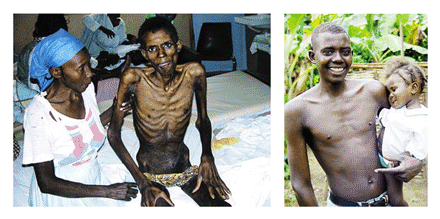
Last year I posted a link to this picture on World AIDS Day. This year I thought I would post the actual picture. I don't exactly have permission to post this image, but I hope that Partners in Health (PIH) would not be mad, because I always use it to help patients in the spirit of PIH's treatment model of free health care for the world's neediest patients. We actually have posters on the walls of our clinic in Busia with this same picture along with explanations in Swahili of the benefits of ARVs for patients with AIDS.

The picture is of a Haitian man with HIV and TB who was (and presumably still is) a patient in the Partners in Health clinic in central Haiti. The left is a "before" image, when he was sick with HIV and TB. The right side is the "after" image, taken just six months later, after he was treated for TB and started on antiretrovirals (ARVs). I generally show this picture to patients before starting them on ARVS. I think it expresses the power of ARV treatment better than any speech I could come up with.

Monday, November 26, 2007

Amsterdam


is too good to be true: picturesque waterways, restored townhouses, tolerant Dutch people zipping around on their bicycles. I didn't make it to many of the museums-- too distracted by the endless bars, cafes, and coffeeshops. The average corner cafe has a wide-selection of Belgian beers on tap, smoked salmon and watercress sandwiches on thick brown bred, and homemade apple cake. Three or four of those establishments on a single block! With so many pubs to patronize, how can anybody be expected to get anything done? We ate (dad with college roommate at candlelit restaurant, at left below) and shopped (wide-eyed sister at bonbon-central, at right below).


I'm back in Busia now, dragging the odd feelings that come with rapid movement between sleek European capital and rural Kenyan village. Downtown Amsterdam vs. downtown Busia pictured below.


Saturday, November 17, 2007

Holland

I'm on vacation in Amsterdam! I'm in heaven. I suddenly don't want to go back to Busia again. I'm going to stay in Amsterdam forever. More to follow.

Sunday, November 11, 2007

Stephin Merritt on Project Song


I'm sick of thinking about global poverty. This article about Jeffrey Sachs pushed me over the edge. One billion people living on less than one dollar a day? I need to block that stat out until I can deal with it. Instead, I'm holed up in our office trying to forget that I'm smack dab in the middle of a community that fits that definition.

I'm entertaining myself with the new NPR music website. I'm not usually a big NPR fan. It's probably just a rebellion thing, because my parents always had it on in the car when I was little. But this new NPR music website is the coolest! They have music reviews, mp3s for download, musician blogs, live concert streams, and "project song" reports.

In Project Song they give a musician 48 hours in a fully equipped studio to write a song that is supposed to be based on a word and a picture. Stephin Merritt, the brilliant lyricist of the Magnetic Fields, wrote a song based on the word 1974 and the picture above left. You can watch a video of the creative process or hear the All Things Considered report here.

By the way, the Magnetic Fields have a new album coming out soon. They are also playing in NYC's Town Hall in February. I want to go if Lola or Yu will go with me.

Saturday, November 03, 2007

New Look

I was just trying to change the margins for a quote on that last post, but the code in the template style box gave me a headache. I changed the whole template instead. I like the colors in the new template, but the margins are still wrong. The body text is too long and skinny, and the side bar is too fat. There's no going back though, this is my new look, at least until tomorrow. Does anybody know how to change the margins? Lola, where are you when I need you?

PLoS Medicine- Poverty and Global Health Issue


Check out PLoS Medicine's October 22nd issue on global poverty and human development:

We asked a wide variety of commentators worldwide—including clinicians, medical researchers, health reporters, policy makers, health activists, and development experts—to name the single intervention that they think would improve the health of those living in poverty. We also asked four individuals living in poor, rural agricultural communities in the Santillana district, province of Huanta, Ayacucho, Peru to give us their response to the question, “What do you think would do the most to improve your health and the health of your family?” (The four community members were Severino Rojas Poma, Mercedes Vargas Soto, Julián De La Cruz Chahua, and Martín Rojas Poma). Our October 2007 Editorial discusses this debate further.

Of note, now that I live outside the ivory tower, I appreciate PLoS's open access publishing. What's with medical journals charging $30 to download scintific studies that were funding by taxpayer money in the first place? This is just another hurdle for students, researcers, medical schools, doctors, and hospitals in poor countries that can't afford subscriptions to scientific journals.

PLoS Medicine believes that medical research is an international public resource. The journal provides an open-access venue for important, peer-reviewed advances in all disciplines. With the ultimate aim of improving human health, we encourage research and comment that address the global burden of disease.

PLoS Medicine (eISSN 1549-1676; ISSN-1549-1277) is an open-access, peer-reviewed medical journal published monthly online by the Public Library of Science (PLoS), a nonprofit organization. The inaugural issue was published on 19 October 2004.

Thursday, November 01, 2007

Mama Chapati


sits right near our office every morning from about 6am to 10am.She makes these delicious things called chapatis, which are like a cross between tortillas and naan. When I walk past her on my way to work she shouts "Karibu Chapati," which I think translates to "welcome chapati," or maybe "you are welcome to chapati." My colleage at work said to to be careful of them, because apparently they "go straight to your hips." I buy one every morning nonetheless. They are definitely worth it.

Saturday, October 27, 2007

Send your old digital camera to Sue Johnson

My friend, the lovely and talented photographer Sue Johnson, has been working with a photography collective in South Africa for the past 3 years. I met Sue in 1987, right after she left St. Cloud Minnesota for college. She had a perm then, and looked a lot like Meg Ryan back in the When Harry Met Sally era. she doesn't look like that anymore, but she still has huge blue eyes and amazing legs. She's married, with two small children who were both born in South Africa. Sometimes she collaborates with her husband Joe on his Radio Diaries documentaries. Haven't heard Thembe's Radio Diary about living with HIV in South Africa? Go immeadiately to www.radiodiaries.org

Back to the photography collective: It's a mix of young people and long-time street photographers. They have been documenting their lives in the townships, one neighborhood at a time. Click on the link above to see their work.

Sue says the group is growing and they need more equipment. They are looking for
used:

* used point and shoot or SLR digital cameras (3.2 Megapixels and up)
* Battery chargers
* Flash Cards or Memory Cards
* laptops
* hard drives
* firewire cables and power chargers
* photography books for the library

If you have any of the above equipment lying around since you bought a newer model, consider donating it to Iliso Labantu. E-mail Sue at sue@suejaye.com, and she will arrange to get your donation to South Africa.

Iliso Labantu -- The Eye of the People

Thursday, October 18, 2007

Neighbors


These women sell roasted corn-on-the-cob at the side of the road near our house. They were delighted when I took their picture (at left above), and even happier when I gave them the hardcopy that I ordered from www.snapfish.com (at right below, with picture in hand). The woman in the middle called me "a nice mzungu." Now everybody on the block wants a picture.

Saturday, October 13, 2007

Found on Office Floor


Actually, right at the office doorstep. James the guard chopped it in half with a stick (note protruding innards). James doesn't know what this type of snake is called in English, but he assures me that it is dangerous.

Saturday, October 06, 2007

Fabulous


This is Christine, the administrative Assistant in our office. She wears fabulous outfits like this one every day. She's going to teach me how to tie an headress. Also, how to carry things on my head. I'm practically the only person in Busia who can't carry a 10 liter bucket full of water on my head.

Friday, October 05, 2007

Homesick


Western Kenya is interesting, but I've been thinking about New York this week. I miss visiting Aoibheann and her beautiful mzungu baby in Brooklyn (pic at left taken last May), then walking to Fort Green to sleep over at Lynnie's. I miss drinking whiskey with Lola while watching the Red Sox whoop the Yankees.

This ("X marks the Spot") made me miss the NYC nightlife. I've also been yearning for a visit to Economy Candy. And of course I miss my sister-- the hostess with the mostest--and her chocolate cake.

Thursday, October 04, 2007

Flood Report

Here is an interview with Elena, our head of mission, about the flooding in South Busia District.

Thursday, September 27, 2007

Floods in Budalangi


Since mid-August there has been flooding in the Budalangi region of Busia District. Part of a dyke near Mukabola health center gave way. The picture above shows people standing at the broken end of the dyke on day it collapsed. Apparently this happens almost every year at the end of the long rains. Year after year, the people in the area are displaced by flooding until the water evaporates and the dyke is repaired. Then they go back to their regular houses, or build a new hut if the old house was destroyed. According to members of our team who work at the health center, the water levels are higher this year and more people are displaced into makeshift camps. I'm hoping they build a stronger dyke this time around. They said the last one was weak becuase it was built by a "lady engineer."

Because MSF is a NGO dedicated to medical care in vulnerable populations, we are focusing mostly on health-related consequences of the floods. Gabriella, the doctor I work with from Argentina (pic in canoe below), goes out by bike, boat, and on foot to make sure the rural clinics have enough medicine and supplies. The logistics department also helped with building latrines and distribution of water tanks, mosquito nets, and water purification tablets. The pictures below show people displaced by the floods in their camps.


Saturday, September 22, 2007

Chauma


I usually eat at home. We have a cook who makes a lot of delicious food. But every once in a while the New Yorker in me feels like eating out. There are only a few restaurants in Busia. Chauma is one of the best.

The only problem with Chauma is that it takes about two hours (minimum) from the time we order to the time the food makes it to the table. We've started going there at noon to order for an 8:00 pm dinner. When I saw the kitchen (pic at left), I understood why it takes so long. There are live chickens (not pictured) that run around until somebody orders chicken. Some of the mini-stoves burn firewood. The staff probably goes foraging for firewood after we order. The food is always delicious though!

Monday, September 10, 2007

HIV, Circumcision, and the Luo People of Western Kenya

The Washington Post ran a story on Friday about the high prevalence of HIV in the Luo tribe of Western Kenya. The article argues that it is due to the Luo tradition of shunning circumcision.

Over the last ten years, large clinical studies have shown an approximate 50% relative risk reduction of HIV with circumscion. I find this counterintuitive. It seems like the foreskin would act like a protective barrier. But this is not the case. A recent review of the subject in the British Medical Journal suggests that the penile foreskin puts men at risk for HIV when it is pulled back during sexual intercourse. HIV can freely enter the non-keratinized mucosa of the inner forskin layer. The outer layer of penile mucosa in circumcised men is keratinized, and therefore more difficult for the HIV virus to enter.

Traditionally the Luo do not circumcise young men, whereas most other tribes in Kenya circumcise boys on the brink of adulthood. The Luo Elders believe that circmcision robs manhood. Instead of circumcision, the Luo traditionally welcomed their young men and women into adulthood by whacking out six front teeth. The Luos I work with in Busia confirm this practice, but say that it stopped back in the 1950s. Many of their parents and grandparents are front toothless.

The Wasington Post's article exaggerates the benefit of circumcision, however. I do not agree with the article's assertion:

AIDS emanated from the jungles of Cameroon or Gabon but hit massive epidemic levels after reaching the uncircumcised tribes around Lake Victoria and, later, southern African tribes that had abandoned their own traditional circumcision rites. These differences help explain why West Africa, where circumcision is routine, has HIV rates much lower than in Southern or East Africa.

Who dreamed that up? How did it get past the editorial staff? It's true that the association between higher HIV risk and lack of circumcision has been shown in many studies, but the effect does not account for the magnitude of AIDS infection in sub-saharan Africa. Lack of circumcision is only one of many known HIV risk factors. Poverty, sexual practices, geographic mobility, prevalence of sexually transmitted diseases, and other complex socioeconomic factors likely all contribute to HIV risk. In the Luo communities, for example, both the fish-mongering economy and the tradition of wife inheritance also contribute to the high HIV prevalence. The practice of trading fish for sex is still a big problem in the fishing communities of Southern Busia district. I do not know much about wife inheritance. I will ask around.

Tuesday, September 04, 2007

Paper-Pusher

I've spent the last few days collecting data and churning out the reports. I did my weekly report for Aug 27th-31st on Friday. On Monday, I started my monthly report for the month of August. Now I'm working on the May-Aug Quarterly report. Every once in a while I break the monotony with a meeting about one of the reports, or writing a report about a meeting. Luckily I will not be here the last week of the year, when some poor sucker will bring in the New Year with a simultaneous weekly report, monthly report, quarterly report, and yearly report.

Sunday, August 26, 2007

Lamu

I spent my vacation on the island of Lamu. Lamu is off the coast of Kenya, just south of the border with Somalia. Of all the bizzare places I have visited in the world, I think Lamu might be the most bizzare. Imagine:

2 mol Kenyan culture + 1 mol Oman + 1 mol Jamaica + 1/2 mol Bronx NYC, + 1/2 mol Saudi Arabia + 3/4 mol misc Europe ------> add heat ------>POW! -----> LAMU

I wish I could post pictures, but unfortunately my camara was stolen by a machete-wielding thief (more on this when the PTSD clears). I will try to use words to describe the island, although my pics would have been better.

There are not cars or bicycles on Lamu. The only forms of transport are donkeys and boats. There are supposedly more than 3000 donkeys in active service. They defecate anywhere they please. The boats--"dhows"--are made entirely of wood. Many of them are hundreds of years old. The masts are tree branches tied together with bits of rope. The sails are a patchwork of misc canvas pieces stitched together painstakingly over the centuries.

Like Zanzibar, Lamu is an ancient civilization that thrived--and probably peaked-- centuries ago, during the slave-trading days. Ancestors of the current residents came from the Middle East, Europe, and mainland Africa. More than three-fourths of current residents are Muslim. It is not easy to get a beer there. The women wear creepy ninja-burkahs; the kind with a narrow slit for the eyes. I took a good pic of a ninja-woman texting on her cell phone while she was riding a donkey through town.

There is a lovely beach 3 km from Lamu town. A bunch of Italians have bought up some of the beachfront property, but you can still walk for kilometers, bothered by nobody except for donkeys and bearded men with sharp machetes who threaten to cut off your head if you don't give them your favorite black bag filled with camera and seashells.

I will buy a new camera soon, so that I can post more pictures of Kenya on this blog. Lamu will live clearly in my memory though. I recommend a visit if you are ever in East Africa. Stay away from the Shela beach down past the castle.

Wednesday, August 15, 2007

Oh Please!

There was an editorial in the New York Times yesterday that questions whether the US really has the best health care system in the world. Does anybody actually think that the US is even in the running? What planet are these people from? If they are from planet Earth, which drugs are they smoking? How about the award for the Most Wasteful Health Care System in the World? That is an award we can actually win.

Saturday, August 11, 2007

Tony Nyadundo Plays Check-In Club


I may not be the Brooklyn vegan, but I just might be the only person blogging about the Busia live music scene. Yes, we have our very own live music venue in Busia-- the famous New Check-In Club. We went on Wednesday to see Tony Nyadundo perform. He plays traditional Luo tribe music--more specifically the Ohangla-style music, which was historically played during beer hall parties. Apparently his newest album is called "Obama," in honor of the Senator from Illinois, whose father hails from the Siaya District, just south of Busia.

When I snapped the pic he shouted "Mzungu" into the microphone, then improvised a little ditty about Mzungus. There's no such thing as anonymity in Busia-town when you are saddled with white skin. Anonymity is one thing I miss about life in New York...

Tuesday, July 31, 2007

Bulwani


I spend most of my time at the Busia District Hospital in Busia town. After two months of begging, however, I finally got to go with the Rural Health Team to the Bulwani Dispensary.

Bulwani is a small village in the south of the Busia District. The trip to Bulwani from Busia township starts with a two-three hour drive over deeply rutted dirt roads. When we came to the end of the road, we stopped at a small dock area on the bank of a stagnant river. We boarded a motorized wood canoe. The boatman navigated our canoe slowly through narrow channels heavily covered with interlocking water weeds (pic above). We got stuck in the weed net a few times. The boatman jumped into the water and hacked away the weed cover with a stick. Thick vegetation lines the banks. Birds and butterflies parked themselves in the trees and fluttered overhead. We passed wood canoes loaded with locals gathering wood and fishing.(pic above.


After about a half an hour, we came to an open expanse of Lake Victoria. Free from the weed network, we sped across the lake for an easy half hour until we again entered a narrow passage.

The passage quickly tapered to a shallow trickle. When we could move no further, we jumped out of the canoe and continued on foot. The water dired up after about 200 meters. We walked on a dirt path that wound its way through small villages for about 45 minutes.

We passed a primary school. The students were playing outside. Within seconds I was surrounded by dozens of schoolgirls who all wanted to touch my weird white skin. A Mzungu must be a rare sight. I felt like a hybrid of red-carpet celebrity mixed with zoo-animal. I survived, however, and we finally made it to the dispensary. The one-way trip took more than four hours. And I thought Busiatown was the middle of nowhere!

Saturday, July 28, 2007

World Music

I like the music in Kenya. The most popular kind of music in Busia is Zaire's Lingala. Lingala is energising dance music--lively vocals mixed with electric guitar, drums, and a a lot of percussion. Benga, the traditional Luo music from Western Kenya, also is also commonly heard around here. It's mostly drums and repetitive male vocals, with long pulsating electric guitar riffs. It's generally not as good as Lingala, in my opinion, but sometimes suits my mood when I feel like slipping into a trace.

Although I miss all the fun I had in Guatemala, I certainly do not miss all the high volume salsa, merenge, and reggaeton. I still listen to Buena Vista Social Club every once in a while and some of the Cuban music I copied from Conrado's collection. (OK, so maybe once in a while I dance around to Shakira's Hips Don't Lie, for old time's sake). Also Mano Chao, of course, who is in the top ten playlist on my ipod. Jenny Davidson linked to a good profile of Manu Chao on her blog.

Wednesday, July 25, 2007

More on MDR

I wish I was at the International AIDS Soceity Conference in Australia this week. They have a special HIV-TB track, where I could submerge myself in the alarming world of HIV-TB coinfection research. I've been thinking about MDR and XDR tuberculosis a lot lately, and actually worrying about it. This is quite unusual for me--I not a big worrier when it comes to things like germs or terrorism or death or other things that normal people worry about.

For those who need something else to keep them up at night, might I suggest a review of the HIV-TB coinfection literature? For lay readers, I recommend an article I stumbled on in the Yale Alumni Magazine . For doctors and scientific-types (that means you dad), the Nature Medicine March 2007 Focus (vol 13, no. 3) is loaded with good stuff.

For those who are too tired to click a link, I am copying John Bartlett's literature review of Neel Gandhi's XDR-TB 2006 Lancet paper below [Gandhi NR; Extensively drug-resistant tuberculosis as a cause of death in patients co-infected with tuberculosis and HIV in a rural area of South Africa; Lancet 2006;368:1575].

The purpose was to assess the prevalence and consequences of multidrug-resistant tuberculosis (MDRTB) and extensively drug-resistant tuberculosis (XDRTB) in KwaZulu Natal, South Africa.

Methods: The authors increased surveillance for MDRTB with sputum cultures and drug susceptibility testing in patients with suspected tuberculosis. The analysis included genotyping of resistant strains and susceptibility testing for first and second line drugs.

Results: Sputum cultures for TB were done on 1,539 patients; this showed 542 (35%) were positive; of these, 221 (40%) were MDRTB and 53 (24%) of the MDRTB were XMDRTB. These results are summarized in the following table:

Total tested 1539
Culture pos 542
MDR M. tuberculosis 221
XDR M. tuberculosis 53
No prior treatment 26 (55%)
HIV pos/no tested 44/44 (100%)
Hospitalized < 2 years 35 (66%)
Mortality 52 (98%)
Median time to death 16 days
Genotype KZN 39/46


Analysis of the 53 cases involving XMDRTB showed only about 50% had received prior therapy for tuberculosis, 2/3 had been hospitalized within the prior two years, and all 44 who had HIV serology were positive. Of particular note was the observation that 52 of the 53 died and the median time to death among these patients from the time of the sputum sample was a median of 16 days.

Genotyping indicated 39 of 46 strains were in the KZN family.

Conclusion: The authors conclude that this study shows the presence and potential serious consequences of XDRTB in resource-limited areas with high rates of HIV, and they emphasize the need for "urgent local and international intervention".

This is an extremely disturbing report that was presented by Dr. Gandhi at the 2006 International AIDS Conference in Toronto; in this report he finished by warning that this strain of TB could undo all of the achievements to date in the international effort to treat and control the HIV epidemic in the developing world. KwaZulu Natal is a rural province in South Africa in which about 80% of patients with active TB have HIV co-infection; mortality rates in those with co-infection are reported as high as 40%/year despite treatment for TB. The authors of the present study note that the rate of MDRTB was only 1.7% when surveyed in 2000-02, but had increased to 9% in 2003-06. XDRTB is defined as MDR (resistance to INH and rifampin) plus resistance to at least three of the six second-line drugs. In the US, these account for about 4% of the MDR strains and up to 15-19% in reports from Korea and Latvia (MMWR 2006;55:301). This susceptibility pattern renders these strains virtually untreatable (Hopewell PC Lancet Infect Dis 2006;6:710). The authors of the report summarized above emphasize four needs:

There needs to be better surveillance to determine the full extent of MDR and XDR tuberculosis in the areas with high prevalence rates of HIV.
Treatment programs need to be strengthened to improve the rates of treatment including access to second line drugs. Infection control practices, especially those within health care settings, need to be enhanced with inclusion of protection of health care workers. There needs to be simpler and more aggressive testing to detect TB and drug resistance in resource-limited areas.

In a more recent editorial comment by Mario Raviglione and Ian Smith (N Engl J Med 2007;356:656) call attention to the unique features of this epidemic that emphasizes the important points noted above. This includes the fact that most of the patients in KwaZulu-Natal province had never been treated, most had been hospitalized suggesting nosocomial acquisition, and all who were tested had HIV infection. XDRTB has been reported in at least 17 countries. Their conclusion is that the "global threat of XDRTB has great significance for the public health field" and "its very existence is a reflection of weakness in tuberculosis management".

Sunday, July 22, 2007

The lab


My work here in Kenya involves very little clinical work. I suppose "Public Health" is the best way to clasify it. Maybe "Program Development" is a good subcategory, or "Monitoring and Evaluation,' perhaps? I don't exactly know. Unfortunately medical education in the United States short-changes public health, in my opinion, so I'm kind-of trying to figure out this job as I go.

My job responsibilities include lab supervision. How do you supervise a lab? Hummmmm...... nonetheless, I've capitalized on my ignorance by asking the lab techs to teach me about what they do. How fun! Catherine (pic above) is my lab mentor. She has taught me how to do gram stains, and AFB stains for TB, and blood smears, and malaria smears, and CD4 counts, etc etc. Perhaps I should have gone into hematology, or even pathology! I managed to snap the weird looking pic above through the microscope. It shows a sliver of my healthy-looking red blood cells. No neutrophils are visible, but let me assure you that they all have lovely segmented nuclei.

Wednesday, July 11, 2007

Hippos


near the shore of Lake Victoria, about an hour away from Busia. I realize this looks more like Tourists Without Borders, rather than MSF, but in reality we actually work too. I'm trying to refrain from writing about our work. It's hard.

Saturday, July 07, 2007

Isolated

I thought I could live without constant internet access, but it turns out that I cannot. Our internet connection is broken half the time and too slow for my impatient side the rest of the time. No TV either. Has anything happened in the world since May 29th? I feel cut off from the world. If anybody feels like sending me their already-read New Yorkers or Economists, I would be grateful.

It will probably get here if you write:

Isolated
c/o MSF-Spain-Kenya
Busia, Keyna
Africa

Or send it to the MSF-Spain Headquarters in Barcelona, and they will send it with the next visitor.

Tuesday, July 03, 2007

Rafting the Nile


Over the weekend I went white water rafting on the Nile. Several companies based in Jinja Uganda run raft and kayak trips starting from the Owen Falls Dam, which is where the Nile exits from Lake Victoria. The dam destroyed Ripon Falls, which is the site that John Hanning Speke deemed the source of the nile in the 19th century.

Digression: Speke originally "discovered" that Ripon Falls was the source of the Nile in 1862, after a 2.5 year schlep on foot from Zanzibar to Sudan. [I put discovered in parenthesis, because some local people get annoyed with this language; they say their ancestors knew that Lake Victoria/Ripon Falls was the source of the Nile long before Speke was a ovum in his mother's ovary.] Speke’s journey is described in detail in Alan Moorehead’s epic The White Nile. Thanks to my parents, I have all 1000 pages of Moorehead’s The White Nile and it’s prequel, The Blue Nile, here with me in Kenya. I know more than I have ever dreamed of knowing about the golden age of British exploration in Africa.

Back to my weekend: We left for Uganda at 6:30 am on Saturday morning. Including border bureaucracy, the drive from Busia to Jinja took more than three hours. Luckily, the rafting company was busy with 30 peace corps volunteers who chose to raft the same day. After signing waivers and forking over more money than the average Ugandan makes in many months, we divided into rafts of 6-8 people and started down the river (pic at left is with Sharon, a midwife from the United States, right before getting into our boat).

According to the Lonely Planet East Africa Guide (and Nile River Explorers promotional material), this 30 kilometer stretch of the Nile has some of the biggest rapids in the world. I'm not expert enough to confirm this, but I can safely say that the rapids are supermassive. Our boat flipped several times, spilling all seven of us into the Nile. Even if the raft stayed bottom down, at least one of us was likely to fly out of the boat on the class IV and class V rapids. On these occasions, we were washed down the river with the current until a kayaker on “search and rescue” duty fished us out and towed us back to the raft. Each time I ended up in the river, as I sputtered and gulped down Nile water and clawed my way to the surface, all I could think about was….. Schistosomiasis!

Despite the near-drowning episodes and the annoying overheard peace corps conversations, it was a great day, and I would do it all over again given the opportunity. We rode back from the take-out point through rural Ugandan villages in an open-backed truck, The kids waved and shouted "How are you Mzungu?" The rafting company supplied BBQ and beers at Bujagali falls afterwards (see pic at right).

Sunday, June 24, 2007

Found on Living Room Floor...


I'm pleased to add this photo to the highly acclaimed "Found on Living Room Floor" series...

Saturday, June 23, 2007

Thank you people!


Tras un mes mirándonos mutuamente las gotas de sudor deslizarse sobre nuestros rostros en la nueva oficina instalada en la casa de los expatriados, Nuria y yo nos vamos tristes por la partida, pero contentas por lo vivido en Puerto Barrios. ¡Gracias gente!