I'm pleased to add this photo to the highly acclaimed "Found on Living Room Floor" series...
Sunday, June 24, 2007
Saturday, June 23, 2007
Thank you people!
Is It Time to Move North?
I was disappointed when MSF-USA told me I could not blog anymore due to security risk. Then Olivier sent me the link to the MSF-Canada website, where they are posting blogs from many of their volunteers, and my disappointment turned into irritation with MSF-USA. I should have known it was a MSF-USA thing, rather than an MSF-International policy. Technically I´m contracted by MSF-USA, although I´m working with the MSF-Spain operational section. I suppose I´m offically beholden to MSF-USA´s rules. I wonder if I could contract with the MSF-Canada office next time...Although then I wouldn´t have health insurance when I get back to the US after my mission. Í would have to buy my medicines to de-worm myself out-of-pocket and add my name to the roster of 40 million uninsured Americans.
Sunday, June 17, 2007
Busia Town
is basically a roadside village, 3 km away from the border between Kenya and Uganda. Boda-Bodas--bicycle taxis--are the primary form of transportation in town. "Taxi" makes them sound more civilized than they actually are.They are actually just old rusty one-speeds with a small cushin behind the driver´s seat for the passenger. They shuttle people up and down the highway between the southern part of town and the group of shops near the border.
I need to schlep the three kilometers between the hospital and our office a few times a day. I used to take the boda-bodas when there was no car available, but even with my eye's clenched shut and my hands gripping the driver I was scared. Now I prefer to ride the old tanker bike that has been passed through generations of Busia ex-pats.
Becuase the boda-boda business is one of the more important sectors of the Busia economy, bicycle repair shops/stands line the highway. This bike repair business, located under the mango tree near our house, repaired the bike I've been riding.
Tuesday, June 12, 2007
Innocent Muzungu* Attacked by Ratty Sheep
I was walking home from the office on Sunday, minding my own business, when a sheep looked up from his grazing, and shot me the evil eye. Before I knew it, he head butted my left thigh with enough force to knock me down in the mud. Gabriella, an Argentinian doctor who weighs no more than 90 pounds, came to my rescue. She was also head butted, but somehow managed to stay on her feet. The pics above are of the perpetrator and victom (note the sheep's-head shaped bruise).
Unfortunately, the whole neighborhood witnessed this ugly attack. Several neighbors approached us on our way home and appologized on the sheep´s behalf.
*Muzungu is Swahili for "white person," as in "how are you Muzungu?¨(frequent greeting by neighborhood children).
Sunday, June 10, 2007
Please remove all liquids and store in a transparent 1liter resealable bag...
It looks like I´m not going to be able to blog much here from Busia. We do have the internet, but the connection is precarious and ssssssssllllllllllllooooooowwwwwww. I´ve aged significantly waiting for this page to load. I´m not even going to try to post a pic, as I´ll reach retirement before it uploads.
Anyway, I just want my friends and family to know that I made it here safely. It took five days to get to Busia from New York, including overnight stops in Barcelona and Nairobi, lost luggage, and cancelled flight. My final itinerary was New York--London--Barcelona--Amsterdam--Nairobi--Kisumu--Busia. I took NYC subway, airtrain, five planes, Barcelona Airbus, and several car/taxi rides. It probably would have only taken four days to get here in the days before the retarded no-liquids-allowed business slowed travel down to a snail´s pace. [Yet another reason to hate George W. Bush.] I had a heated discussion with security about whether bug repellant counts as a true spray. The security tech thought the only spray permitted is deodorant.
Anyway, I made it here eventually. I am adjusting slowly. More details if I find a better internet connection someday...
Tuesday, June 05, 2007
Las fiestas Gallo del pueblo
La semana pasada fueron las fiestas de Puerto Barrios. Y con el patrocinio de Gallo, la mejor cerveza de Guatemala, cuyos dueños poseen la mayor parte de la zona 2 de la ciudad capital, incluyendo una iglesia que alquilan a precio de oro para las bodas, bautizos y demás acontecimientos sociales de la elite económica guatemalteca, se
colocaron unas casetas donde se ofertaba, además de la bebida amarilla, churrascos y tortillas. También había atracciones como la noria, el barco vikingo o los carros locos, todo aderezado con mucho ruido y luces de colores.Pero uno de los acontecimientos más esperados de la feria fue el jaripeo, al que tuve el gusto de asistir. Como podrán observar en la foto de la derecha también estaba patrocinado por Bebidas Centroamericanas SA, y su producto estrella, ¡¡la Gallooooo!! –cientos de veces nos hicieron escuchar esta frase; cada artista, cada bailarín, cada presentador que salía la repetía-. Las chicas y chicos Gallo amenizaron la primera hora del espectáculo con música, baile y un concurso cuyo premio era una camiseta (playera) con el logotipo de... ¡¡Gallo!!
Después, tras una oración -con el sombrero a lo cowboy entre las piernas en señal de respecto-, comenzó la monta de toros. El que más duró encima del toro fue uno de chiquimulilla que tardó ocho segundos en caer a la arena.
Al salir del foro, nos vimos delante de un escenario sobre el que tres chicas vestidas con logotipos de Gallo bailaban. Y después, me fui a tomar unas gallos.
Friday, June 01, 2007
Curiosidades
Ayer vi un programa de televisión muy interesante de una cadena española. Normalmente en España pasan este tipo de programas muy tarde, ya en la madrugada, pero por la diferencia horaria, lo pude ver a las 10 de la noche desde Guatemala. El programa que pasaron ayer trataba de responder a la pregunta de si existen diferencias culturales en la forma de sentir. Llegaron a la conclusión de que todos somos desde el punto de vista genético exactos, por tanto, nacemos con las mismas emociones, independientemente del lugar o contexto en el lo hagamos. Si bien, las diferentes culturas dan mayor importancia a unas emociones que otras. Es decir, todos sentimos las mismas emociones, pero no tenemos la misma capacidad de identificarlas, porque en nuestro entorno no se le ha dado relevancia o porque no tenemos la palabra en nuestro idioma. Hay muchos conceptos que están codificados en una lengua y no en las otras. Por ejemplo, aunque no me dio tiempo de apuntar todos las palabras que iban apareciendo en la pantalla, y casi me mato subiendo y bajando los escalones buscando desesperada algo con lo que escribir, pao heo heo, en Hawai es una palabra que significa “volver de la pesca sin peces”; queesting, en holandés significa dejar a tu amante entrar en tu cama, debajo de las sábanas, para tener únicamente una charla; sgriob en escocés es “el picorcillo del labio superior antes de tomar un trago de whisky”; y una muy buena es senzuri, la palabra japonesa para la masturbación masculina (literalmente “cientos de frotaciones”). Shiko shiko manzuri es la versión femenina (literalmente “10.000 frotaciones”).
Después de algunas semanas de debate interno sobre mi futuro en el mundo humanitario, al ver este programa resurgió de las cenizas uno de los motivos por los que acabé siendo cooperante: la curiosidad.
Tuesday, May 29, 2007
No Blogging Allowed!?
I went downtown to 29th street at 7th Avenue in Manhattan again today for my pre-mission New York briefing. This one was much shorter than the last one. The bad news: MSF New York says "no blogging allowed." Well, it was not quite as cut and dry as as that, but still a major disappointment.
The communications department told me that blogs are "too live." They say some blogs were getting overly specific about daily activities and routines, and they think it has turned into a security risk. I can understand this concern in unstable settings, of course, where there is risk of violence or attack on humanitarian workers. But what about in places like Puerto Barrios, Guatemala? Does it really hurt to describe the pig-grilling routine for our goodbye parties?
Anyway, I discussed the issue a bit more in depth with my HR officer. She said there have also been problems with patient confidentiality. Any American MD who has survived HIPPA knows better than to post pictures or identities of patients. We came to the conclusion that if I blogged only about 'personal things' it might be OK to keep Whatonearthamidoinghere alive. Of course, 99.9% of my 'personal things' are of no interest to anybody. I don't think a list of my souvenir purchases or a detailed description of my new suitcase-on-wheels is worth posting.
I will discuss the issue a bit more with the Head of Mission, who has the final say, I was told. Hopefully I will be able to post a few pics of Kenya and my team. In any case, I will stay away from project specifics and the inner workings of MSF here on blogger. It looks like I will have to save these juicy details for my private journal and hippocampal grey matter.
Monday, May 28, 2007
Busia, Kenya

Tomorrow I am leaving for Busia, Kenia, by way of Barcelona. I am going to work on another project with MSF/Doctors Without Borders. Busia is in Western Kenya, right on the border with Uganda. It is right near the shore of Lake
Victoria. The closest town on the map is Kisumu, which is actually two hours southeast of Busia via car.
I do not know much about MSF's history or current work in Kenya. I do know that the Busia project is another HIV/AIDS project. Like Puerto Barrios, Busia is hot and humid. One of the biggest differences from Guatemala is the prevalence of HIV/AIDS in the area. In Busia, about 15-20% of the population is infected with HIV; Izabal Guatemala has about 1% prevalence. I know nothing about the people I will be living with and working with in Kenya.
I do not know if I will have access to the internet, and if so, how much. My guess is that I will manage to post pictures and bits on this blog every once in a while. Stay tuned...
Friday, May 25, 2007
What on Earth Are We Doing Here?
Dear Confused Friends:
That last post was written by my friend Maria de los Angeles Navarro, the Puerto Barrios logistician. [Pic at right is of Angeles looking effortlessly beautiful, as usual.] A few of you might not have understood what she wrote. She uses words that are difficult for those of us with language learning disabilities and/or hypoplastic left temporal hemispheres. Nevertheless, I hope she keeps writing entries from Guatemala. It gives the blog more of an international flavor, don't you think? And we would also keep up on the progress of MSF's work in Guatemala, not to mention gossip from Barrios. Hopefully I will find a few other willing blog contributors from the MSF staff I meet in Spain or in Africa.
Sincerely,
--Housesitting in luxury Soho loft, and readying myself to go to Kenya
Sunday, May 20, 2007
The last party-La última fiesta
Hace ya más de un mes
que se celebró la fiesta de despedida de Nell. Y esa fue la última fiesta de despedida que se celebró en Puerto Barrios. A diferencia de la fiesta de Sole y Rafa no hubo ningún cochino muerto. La ausencia del cerdo se compensó con mucha ensalada, guacamole y papalinas, litros de ron y unos chorizos a la brasa como único producto de origen animal. La foto de la izquierda corresponde al momento en que la fiesta se animó después de que todos habían probado el mojito especial y a alguien se le ocurrió poner música punta. De tanta gente que llegó, entre compañeros, trabajadores de los centros de salud y hospitales, y amigos de amigos, no cabía un alfiler. Como en todas las fiestas que
se precien hubo alguna pelea, algún estropicio, bastantes borrachos y mucho baile. Hubo música para todos los gustos, cuando en un acto de ludicez a Nell se le ocurrió poner rock!! No tan estúpida, eh? Aunque no se salvó de bailar un merengue a lo guatemalteco. Hasta las cinco de la madrugada tuvieron que escuchar nuestros vecinos el jaleo -aunque creo que alguno se animó y se vino a echar un bailoteo-. Al día siguiente con los ojos pegados todavía despedimos en Litegua a Nuria, Jose Luís y Nell que se iban de vacaciones de semana santa. Más tarde Conrado se fue para Livington (punto). Y el fin de semana se presentó para la que suscribe como un entrenamiento de lo que vendría después. Osea, ahora. Empecemos a recoger el tinglao que se acabaron las fiestas.
Tuesday, April 17, 2007
Man over machine...
I have a lot to report. Since my last post, I've bounced from Quetzaltenango to Guatemala City, to San Jose Costa Rica, to Madrid, to Barcelona, then to Frankfurt, and finally landed here in New York. I've debriefed in the MSF offices in Guatemala, Barcelona, and New York. I've officially survivied my first mission!
Unfortunately, my camera and laptop are not as lucky. Both are sick with viruses, I presume. I cannot post pictures, and I can't even open my computer without beeps and and flashes and warnings that my system is vulnerable. I was on the phone with the Dell Software Tech for SEVEN hours on Sunday. It was an heroic effort, but when we said our goodbyes she said "your machine is deeply infiltrated." I'm writing now on a borrowed computer. This is just another example of human triumph over machines, I might add (remember the Matrix?). I am in great shape, but the gadgets couldn't survive the demands of their first mission with MSF.
More details and pics when the gadgets are repaired or replaced...
Saturday, April 07, 2007
Más Semana Santa
Friday, April 06, 2007
Semana Santa
There are many processions through the city. These parades have a stronger ceremonial feel than their North American counterparts, such as a 4th of July or Macy´s Thanksgiving Day parade. I suspect it has something to do with the religious element. I thought about asking the people standing next to me to explain what was going on, but that ugly Jews-killed-Jesus business always seems to come up this time of year. I kept my big mouth shut.
My observations: the processions are dominated by the purple-robed people. The elders line the crowd and clear the way for the statue-bearers. The statue bearers are younger purple people, charged with lugging the heavy statues of Jesus et. al.
through the streets. White-clad incense bearers scuttle back and forth between statue bearers.
Then come the girls in bridal veils. In the procession this morning, the girls carried a sign that said "virgins." The virgins were followed by the buff statue-bearing ladies (not pictured). The band brings up the rear, playing somber religious numbers.
They are a staple in El Salvador, but popular here in Guatemala too.
Thursday, April 05, 2007
Goodbye Dreamteam...
This is the last pic I snapped of our Puerto Barrios team. From left, Jose Luis (doctor, Patagonia Argentina), Àngeles (logistician, Cadiz Spain), Conrado (nurse, Medellin Colombia), Nell (spaz, nomadland), Nuria (nurse and coordination, Canary Islands Spain).
I miss them already. Trying hard to detach on my vacation. Nuria´s head is blocking out my new beefy phisique.
Dysphoric No More
Over the past several months, I have been feeling increasingly certain that the username "Dysphoric" no longer suits me. This is a very good sign, ¿no? Sure, I want to paint it black most of the time, and I´m usually the most cynical voice in the conversation. But what about all the good times? How can somebody who has so much fun call herself dysphoric? I may just quit my often overwhelmingly sad day job and try my hand as an aging rock-star (pic at left on air drums during car ride to Coban, Alta Verapaz).
So, I kill you off, dysphoric. I now go by the name nomad. Funny-- all I had to do to feel better was escape the NYC psychiatrists for a year (no offense Susan, Tanya, Andrea...)
Wednesday, April 04, 2007
Vacation
The green tree-like thing at right is part of the Semana Santa festivities. Everybody is carrying around palm-type leaves. I´m not sure why.
Below right is a mask shop in Chichicastenango.
Monday, April 02, 2007
New Atul Gawande Collection

Is there anything Atul Gawande can´t do? He works as a surgeon at one of the most prodigious academic hospitals in the world; he has published dozens of fascinating medical-related essays in the New Yorker, his second book is about to hit the shelves, and he is the father of three undoubtedly brilliant and beautiful children. All that, plus great taste in music! The New York Times discusses his second book and ipod playlist today.
If you have not read any of Gawande´s essays, I recommend that you correct that ASAP. His first collection, Complications, is widely available. Or, click here to read Naked, a short essay about the physical exam that was originally published in the New England Journal of Medicine in 2005.
I am on vacation, by the way. In addition to coveting Atul Gawande´s talent, I am catching up on book reviews online and exploring the Western Guatemalan highlands.
Monday, March 26, 2007
Takes My Breath Away
Thursday, March 01, 2007
Going Home
The Doctors Without Borders headquarters in New York sent me an email last week. I am booked on a flight from Barcelona to New York on Friday April 13th. I have to go from Guatemala to Barcelona "on my way back" to New York for a Debriefing with the MSF-España staff. I will debrief the week of April 9-April 13th.
I am going home! I will smother my loved ones with kisses. New York in the Spring: the music, the books, the art, the sushi, the smell of urine in the subway! All the languages and smells and different-sized people everywhere. ... the creative geniuses crowding the streets, bumping into the brainless bigots and mentally ill ....There are at least 15 single-malt whiskys I´m dying to try up in Angel Share, on 9th St., near St. Mark´s. Then I'll walk over to Moishe's on 2nd Ave and eat some Triangles and a Babka or two. I am super excited (no ironic tone here--I am told it is hard to tell).
But, my excitement is not without ambivalence, I´m afraid. I will miss my fabulous teammates/housemates, who have been half temporary siblings and half best friends. What will happen to our clinic? To our patients? Also, as my remaining time here in Guatemala shrinks, a few ugly little thoughts nag my brain. For the last 8 months I have had to shamefully admit my citizenship to people who think of the US as a land of bullies, war-mongers, and money-grubbers, rather than the Land of the Free and Home of the Brave. Now I´m going back to commune with the bullies and money-grubbers. "The people are different than the government," I´ve said. Well, some of us are kind-of OK. Right? I think so. Whatever the truth may be, I need to rest my overworked shame receptors for a bit. They are so tired...
My life has changed while I have been away. I don´t have an apartment or house in the US, for example. And, oh yeah, I don´t have a job either. Freedom! Opportunity! Fear of Health Insurance lapse! United States--here I come.
Working Hard in Guatemala
Tuesday, February 20, 2007
Logistics

Expertise in logistics is one of MSF´s greatest strengths. Efficient logisticians get supplies to disaster sites quickly after an emergency.
They also are in charge of security, administration, and finances in the field. Most of all, they are problem solvers, the handy-types with common sense (Lola Evans, you were born for this job!). If the lights go out, go find the logistician. What?? There is no Fluconazole? Tell logistics I need it by tomorrow.
They also are in charge of security, administration, and finances in the field. Most of all, they are problem solvers, the handy-types with common sense (Lola Evans, you were born for this job!). If the lights go out, go find the logistician. What?? There is no Fluconazole? Tell logistics I need it by tomorrow.Logisticians come from diverse backgrounds, training, and education. Some of them are ex-military, some are engineers, some mechanics, and others are water or sanitation experts.
Mary Ángeles (at left, in black sweater), our current logistician in Puerto Barrios, says that the most important quality in a logistician is curiosity and willingness to learn new skills. She also says it is the best job if you are a woman who happens to like men, as the male:female ratio is about 6:1. 
These pics are from the logistics conference that Angles and Rafa attended in January. There were 25 men and four women. They had workshops on car fixin, water chlorination, antennas, and how to play tug-of-war with your vehicle. Note Rafa´s butt in pic below right, just in front of the rear wheel).
Sunday, February 18, 2007
Monday, February 05, 2007
Marvin, ELAM, and Cuban Doctors
The
There happens to be an article just this week in Slate about ELAM and Cuba´s system of medical education. It reports that Cuba has more doctors per capita than any other country in the world. Another recent article in the Economist discusses Cuba´s tradition of exporting doctors to sites that need medical help after natural disasters and emergencies. The article says that about 1 out of every 3 Cuban doctors practices outside the country at any one time.
Marvin (pic at left) is the new doctor I am working with at the Hospital Nacional Puerto Barrios. He will take over as the Infectious Disease clinic doctor when MSF leaves Puerto Barrios. Over the next couple of months we will see patients together. I am teaching him everything I know about HIV.
Marvin was born in Coban Guatemala. He went to medical school in Cuba. He was in the first graduating class at the Latin America School of Medicine in Havana Cuba (also known as ELAM). After he graduated in 2005, he returned to Guatemala to work.
ELAM is a fascinating place. It is one of the largest medical schools in the world, and certainly the most diverse. There are currently about 10,000 matriculating medical students from more than 25 different countries (the majority are from Latin America). The school trains students from poor countries who do not have access to medical education. All students are given free tuition, room, and board for six years while they study medicine in Havana. They are encouraged to return to their home countries to practice medicine after they graduate.
There are currently about 100 ELAM students from the United States. The students are recruited and screened by the Interreligous Foundation for Community Organization (IFCO). Most of the North Americans at ELAM are from underrepresented minorities in US medicine.
There happens to be an article just this week in Slate about ELAM and Cuba´s system of medical education. It reports that Cuba has more doctors per capita than any other country in the world. Another recent article in the Economist discusses Cuba´s tradition of exporting doctors to sites that need medical help after natural disasters and emergencies. The article says that about 1 out of every 3 Cuban doctors practices outside the country at any one time.
How is it that Cuba can afford to train poor American minority students while the US can't manage to do so? How can Cuba manage to send thousands of doctors abroad to take care of the poor after International Emergencies and Humanitarian crisis, while almost all of the doctors in the US are too busy trying to pay off their medical school debt (average debt of graduating medical students in the US is currently somewhere around $100,000)?
Saturday, February 03, 2007
Mancos, Tuertos, and My Weekend Strike
My Spanish is improving at an infinitesimally slow pace. The process of learning a language in my old age has made me appreciate the importance of words in a whole new light. I never realized how important it is to my well-being to have just the right word to express my idea or feeling at any particular time. The converse, of course, is the frustration of not having the right word, and having to choose the next best available choice, which is often does not convey anywhere near the idea I want to express. What´s the point of talking at all?
But, as I get better, I am starting to think that Spanish is a better language than English. I´m no linguist, obviously, but Spanish seems to be more organized, for one, with more rules and less randomness than English. You can make verbs from the nouns, and nouns from the verbs. You can increase and decrease the size of things simply by tacking on an ito or issimo to the end of your adjective. And there are many important words that have no English translation. For example:
Manco- A person with one arm
Tuerto-- A person with one eye
Cojo-- A person with one leg
Also, Madrugar (to get up at the crack of dawn), is a handy word for an unpleasant concept.
Despite the above advantages, it has been hard to live in a world where I don´t have the slang I need and I can´t throw around bad grammar just for fun, like I do in English. I tire of sounding stupid and being misunderstood. I am on strike this weekend, actually. No more Spanish for me until Monday. I need my rest, as I had to madrugar today to round at the hospital. There is a tuerto on my service who needed some attention.
Tuesday, January 30, 2007
Advertisment
The Fever, a monologue written and realized by my beloved uncle Wallace Shawn, opened this week at the Acorn Theater in midtown Manhattan. Scott Elliott, the dramatic mastermind behind last year´s HurlyBurly, is directing the production for the New Group.
Whatever you do, do not believe the review today in the New York Times (which I will NOT link here), which includes some ridiculous drivel about the play running on too long. I have not seen the current production, but the two other times I have seen Wally do the play, they were not a second too long nor a second too short. They were perfect.
All of Wally´s plays are thought-provoking. This is one of the reasons I like them. The Fever is one of my absolute favorites. Granted, it can be difficult to accept some of the ugly thoughts and feelings that the play evokes, but that´s the point, dummy. The play addresses topics I think about constantly, including the discomfort that (relatively) rich visitors feel when travelling in (relatively) poor countries. But enough of my commentary--go see the play yourself. Wish I could be there too.
Sunday, January 21, 2007
Case Record Continued...
Case Discussion: A 28 year old man with cough and fever, two weeks after starting Antiretroviral Therapy.
Sorry to Rafa and the other bored-by-medicine folk, but the comments on this case are really too good to leave hidden in the comments section of that last post. For those who missed them, Doctora Lola (Pulmonary Critical Care Specialist and ICU Director at one of NYC´s largest medical centers) said:
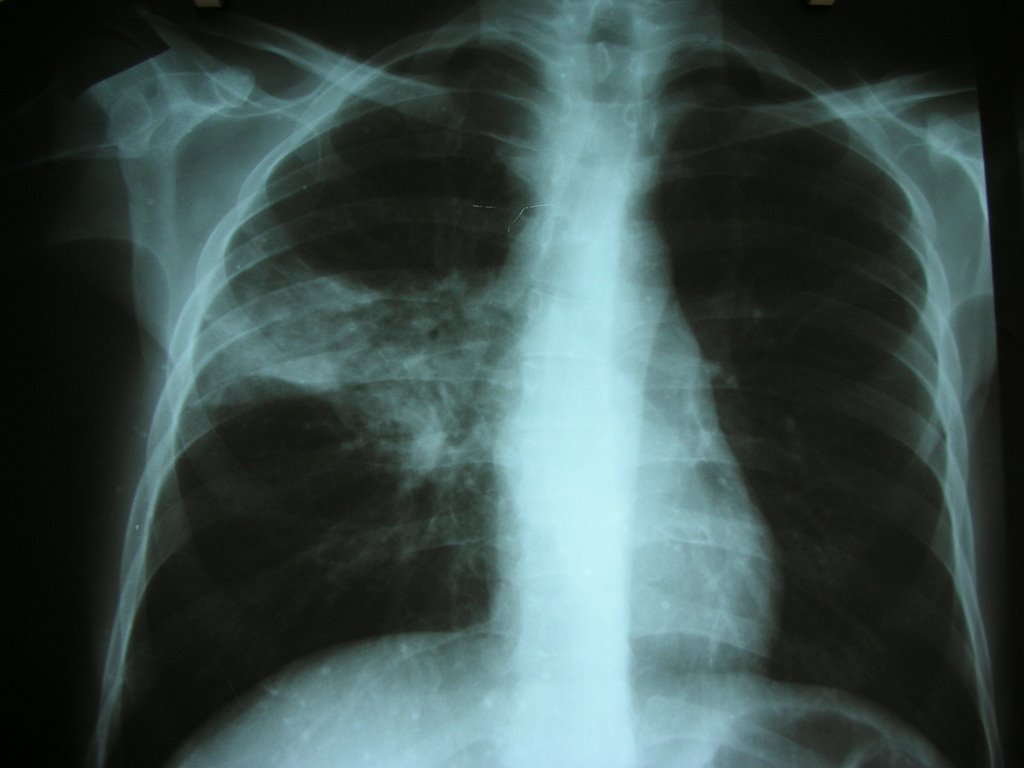
The differential is broad, although several elements of the history stand out to me as important; first he had 3 negative smears for AFB upon his initial diagnosis, second he had presumably been taking is PCP prophylaxis, third, he does not sound acutely ill on presentation to the MSF clinic, and lastly his symptoms began a couple weeks after the initiation of antiretroviral therapy. His CXR is certainly abnormal, with lower lobe predominant bilateral interstitial and micronodular infiltrates (one could use the ubiquitous radiologists term "reticulonodular infiltrates"). While the image quality is not perfect, he doesn't appear to have significant lymphadenopathy on the film. This radiographic pattern in an HIV patient is non-specific and could be many things, both infectious and non-infectious. Given his clinical course, infectious causes seem most likely, particularly with a possible element of immune reconstitution with him recently starting HIV meds. The infections I think are most likely are 1. PCP (despite prophylaxis), 2. TB, 3. Community acquired pneumonia 4. MAI (CD4 is a little high). Non-infectious etilogies to consider (although much less likely) are lymphocytic interstitial pneumonia, hypersensitivity pneumonitis and drug reaction.
Doctora Magda (Infectious Disease Consultant and HIV Researcher at another NYC mega-medical center) said:
I agree with Lola and think that IRIS is a real possibility, although his initial CD4 cell count was fairly high at 160. The risk of immune reconstitution increases with lower CD4 cell counts at the time of ART initiation. Of course, there are never any absolutes. I was curous whether you rechecked his eosinophils at his second presentation - I would also add strongyloides (hyperinfestation) to his ddx
Amazingly, the Puerto Barrios Community doc had arrived at the same differential diagnosis as the New York academic specialists! [Perhaps not all that amazing afterall, as I learned almost everything I know from these two bad-asses.)
I thought that infectious etiology was most likely, given the patient´s low grade fever and cough, along with the CXR results. The reticulonodular pattern on CXR was most suggestive of PCP, and the patient´s CD4 count of 160 would be consistent with this diagnosis. However, the pateint insisted that he had been taking his Trimethroprim, and I believed him. This would make PCP much less likely. Even though the patient had been AFB negative x 3 prior to starting his antiretrovirals, we all know that AFB smear is only about 50% sensitive in HIV positive patients with TB. I thought the likelihood of immune-reconstitution syndrome (IRS) with recognition of a previously undiagnosed TB infection was a real possibility. Of course Dr. Magda´s comment that IRIS is most commonly seen in patients with very low CD4 counts crossed my mind, making this diagnosis a bit less likely in our patient with CD4 of 160. I did not think about strongoloides hyperinfection. It is a great thought though, because we see a lot of strongoloides here (stool smears for parasites are one of the few strengths of our lab here in PB), and immunosuppresed patients are at high risk for hyperinfection.
So what is Immune Reconstitution (IRIS) anyway? I am no expert. My understanding is basically that as AIDS patients replenish their CD4 counts and their immune systems recover, the T-cells start fighting infectious that they previously did not have the energy to notice. A 2004 review in Clinical Infectious Diseases describes IRIS as:
an inflammatory syndrome occurring days to months after the start of ART, with outcomes ranging from minimal morbidity to fatal progression. This syndrome can be elicited by infectious and noninfectious antigens. Microbiologically, the possible pathogenic pathways involve recognition of antigens associated with ongoing infection or recognition of persisting antigens associated with past (nonreplicating) infection.
About 25-50% of IRIS cases are thought to be due to mycobacterial disease that was subclinical prior to starting antiretroviral therapy.
So what happened with the patient? I started him on empiric treatment for PCP as an outpatient and told him to drop off as many sputum samples as possible at the Centro De Salud for AFB analysis. He came back the next week with three samples +++ for AFB. I stopped the PCP treatment and told him to go back to the Centro de Salud STAT to get TB treatment. He is now on four drugs for tuberculosis and continues on Anti-retrovirals.
Thanks Lola and Magda! I miss you.
Monday, January 15, 2007
Case Records of the Hospital Nacional, Puerto Barrios
Case Records of the Hospital Nacional, Puerto Barrios: A 28 year-old man With Cough and Fever, 2 Weeks After Starting Antiretroviral Medicine
Sr. L is a 28 year old man who lives in Eastern Guatemala. He was well until the fall of 2006, when he began to lose weight and feel weak. He also noted fevers and watery diarrhea. He did not have a cough. He went to a neighborhood doctor, who took blood for lab tests. Results of initial labs showed WBC 9,100 (55% PMS, 42% lymphs, 3% Eos), Hg 9, Hct 28, AST 64, ALT 63. A stool study was positive for Entamoeba Histolytica. Three sputum smears were negative for AFB. Rapid HIV test was positive. He was referred to the MSF clinic, Hospital Nacional, Puerto Barrios.
We saw him for the first time on Oct 9th. He recounted the history outlined above. He has no other past medical or surgical history. He takes no medicine. He has no known allergies. He lives with his wife, who is pregnant, and 7 year old son. He is currently unemployed; he used to work as a salesman. He used to drink beer every day, but stopped when he found out he was HIV positive (one week before he came to our clinic). He does not use drugs or smoke tobacco. Reviews of systems was otherwise unremarkable. His exam was notable for a young man who appeared thin, but not acutely ill. His weight was 43 kgs, height 158 cm (BMI 17), pulse 92 and he was breathing comfortably. His conjunctiva were pale pink and nailbeds pale: he had oral thrush. His thorax and cardiovascular, and abdominal exams were normal.
Our initial impression was a 28 year old man with AIDS (CDC stage B), anemia, mild transaminitis, and Entamoebia Histolytica. We ordered a CD4 count. Our lab cannot do any tests that are not listed above. We follow the Guatemalan National Protocol for TB screening (they do not screen for latent disease). We started him on 1 double strength TMP-SMX daily (PCP prophylaxis) and Metronidazole 500 mg q8 for 14 days (E. Histolytica treatment).
He returned for a follow-up visit three weeks later. He did not have any new complaints. His CD4 count came back at 160. He was seen by the social worker and psychologist, and was approved by the Committee for Anti-Retroviral therapy. In mid-December, we started him on Nevirapine, 3TC, and D4T. He continued Trimethroprim prophylaxis, and reported adherence to this therapy.
He returned two weeks after starting Antiretrovirals complaining of a productive cough, fever, and shortness of breath on exertion for 1 week. He denied diarrhea and other GI and cardiac symptoms. His weight was 44 kgs, temp 37,5 degrees C, pulse 112, and RR 22. His lung exam was notable for few scattered crackles bilaterally, bases more than apexes. His Chest X-ray is shown above.
Ideas? Differential Diagnosis? I thought it might be interesting to compare what the work-up would be in an academic center in New York verses Puerto Barrios, where diagnostic tests are limited (to say the least). What says my Director of ICU Megalopolis Academician Geniusy Amigita Lolita?
On the Living Room Floor...
Sunday, January 07, 2007
Goodbye Rafa
Rafa, Project Barrios Logistician, is leaving next week. He is going to a MSF Logistics training course/conference near Bogotá Colombia, then home to País Vasco (aka Basque Country). Happily, Ángeles, the former logistician for the Olopa Chagas Disease project, will take Rafa´s place.
We had a party on Friday night to say goodbye to Rafa, Dolors, and Jairo, and to welcome Ángeles. Conrado and Rafa arranged to buy a pig several weeks before the party. They snapped the above pic on a site visit to ensure the pig was fat enough to feed the expected guests.
The day of the party, Norma hacked the pig to bits with an ax (pic at right). Droplets of piggy-juice flew everywhere. It was disgusting. If I was not a vegetarian already, I´m sure this sight would have converted me.
I will not describe the details of the beer and liquor purchase, as I did not get a picture of the bottles, and I´m sure nobody will believe me without it. It will suffice to say that we bought enough to double or triple the LFTs of 80 guests.
Pichi barbecued pig meats while Norma made stew from various internal organs. We also made guacamole, yucca, salad, tortillas, and mojitos. The guests feasted like ravenous carnivores. Magdalena (at left) said the food tasted good. I spent my time documenting the transformation from cute piggy to bubbling stew, the last pork incarnation pictured at right.
I am in no mood to deal with my sentimental side, so I will not ramble about how much we will miss Rafa etc etc. I just hope he will eat more of this stew before he leaves, so we can get this pig out of our fridge.
Tuesday, January 02, 2007
The Family Visits
My family and a couple of friends from New York visited me in Eastern Guatemala over the weekend. If big smiles are an accurate indicator, they appeared to enjoy the trip (despite bats in the bungalows and other assorted minor mishaps).We traveled down the Rio Dulce to the mouth of Lago Izabal. Mom kayaked and toured the nearby village. Her less active offspring drank beers and watched the sunset over the river.
After my parents left on Dec 31st (pic at right
below), we boated back to Livingston. Somebody in the boat mistook my sister for an Evangelical. There is a first time for everything, I suppose. Back in Livingston, we drank and danced in the new year with Conrado, Rafa, and Pichi. Jenny´s smile (above) is just after midnight, Jan 1 2007.
I spent the weekend feeling fortunate that I have such an amazing family!
Wednesday, December 27, 2006
On Tuberculosis and Bureaucracy
I am living a Tuberculosis nightmare. I get agitated when I think about it. I wish I had a sedative to calm my nerves as I write this.The background: HIV and TB are a deadly combination. Unfortunately, they are also both common diseases. One-third (1/3) of the world´s population has been exposed to tuberculosis and is walking around with latent disease.
Most HIV-negative people do not get sick with active TB after they have been exposed. A healthy immune system usually controls the TB mycobacterium. Nevertheless, a few scattered mycobacteria hide away, alive and well, even in the healthiest of hosts. This is called latent disease. Should the host become immunosuppresed, the hidden mycobacteria are more likely to "reactivate"--multiply out of control and blossom into an active TB infection.
HIV positive people who have been exposed to TB are 100 times more likely to get sick with active disease than non-HIV patients. Not only does HIV make TB worse, but TB makes HIV worse. HIV patients with active TB have higher HIV viral loads, and their CD4 counts fall faster than patients without TB. Many patients with HIV and TB coinfection die. In fact, tuberculosis is the leading cause of death in HIV positive patients worldwide-- most certainly in places like Puerto Barrios Guatemala.
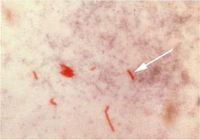
Doctors can usually diagnose TB in HIV-negative patients by ordering a sputum smear (pic at right). (1) Cough up glob of phlegm. (2) Smear phlegm onto microscope slide. (3) Throw on a few drops of dye. (4) look at slide under microscope. If pink "acid fast bacilli" are visible, the patient is deemed "AFB positive," and treated for active tuberculosis.
Unfortunately, smears are not a good way to diagnose TB in HIV positive patients. About 50% of HIV patients with active TB are "smear negative," which means that no organisms are seen under the microscope, even when the patient is swarming with them. The best way to diagnose TB in smear negative HIV patients is to send phlegm or other body fluid-- blood, cerebral spinal fluid, or urine-- for culture. Or, if you want to spend even more money, you can send the sample for a fancy DNA amplification test called PCR. Unfortunately, many "resource-constrained" (aka poor) places cannot afford to do TB cultures, much less PCR.
Public health authoçrities like the World Health Organization and the CDC have woken-up to the TB/HIV coinfection emergency. They also seem to have realized that poor countries cannot always send cultures, and therefore have trouble diagnosing smear negative patients. WHO recently published guidelines for diagnosing and treating smear-negative coinfected patients in resource constrained settings. These guidelines urge doctors to treat smear negative patients even in the absence of a confirmatory culture. When HIV positive patients have signs and symptoms of TB ("high- suspicion" patients), the guidelines recommend treatment, even if smears are negative and no cultures are available.

Unfortunately, the Guatemalan Ministry of Tuberculosis has not read the WHO guidelines. Or maybe they think Guatemalan coinfected patients are different from coinfected patients in other countries around the globe. Who knows what they are thinking? All I know is that many of our smear-negative patients cannot get treatment.
You can walk into almost any pharmacy in Guatemala and buy antibiotics, sedatives, narcotics, proton pump inhibitors, mega-dose injectable vitamin B12, and kill-your-kidney injectable NSAIDS without a prescription. But you cannot buy INH, Rifampin, or Ethambutol, the drugs used to treat TB. these drugs are only available from the Centros de Salud (primary health care centers). Unfortunately, when we send our smear-negative patients to the Centros de Salud for treatment, they are often told that they cannot get treatment unless they have a positive smear or culture. Our letters and phone calls are not much help.
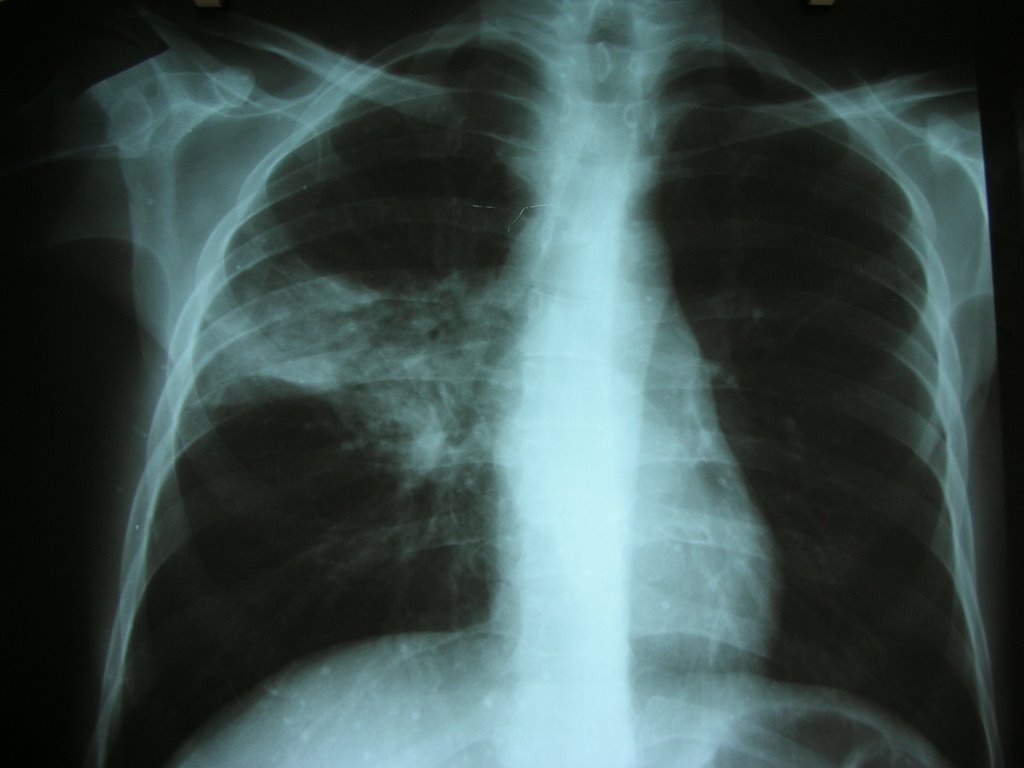
What happens to our patients? An example: A 42 year old man with HIV, previously doing well on antiretroviral therapy came to the clinic with cough for a couple of weeks. We gave him antibiotics, an "empiric" treatment for bacterial pneumonia, and sent three sputum smears for AFB. All the smears came back negative. He was no better in a couple of weeks. He was losing weight and he looked weak and tired. We sent him for a chest X-ray (shown above right). It does not take a pulmonologist or radiologist to see that the left side is different than the right side. Hummm.... HIV positive, cough, weight loss, night sweats, not better with antibiotics.... could it be... TB??? But when we sent the patient to the health center with a letter and a copy of his X-ray, he was told he could not get TB treatment because his smear was negative. The health center employee would need to write a letter to the central office in Guatemala. If they approve empiric treatment in one of their upcoming meetings, the patient might be approved for empiric treatment. In the meantime, he would have to wait. It could take weeks, even months for the central office to get to his case. I blew my stack when he came back and told me the story. My temper tantrums do not help.
Until Guatemala changes it´s practice for management of smear negative TB in HIV positive patients, our patients are in serious trouble. In fact, we are all in serious trouble. I can only hold my breath for so long, before I breathe in one too many AFBs.
Subscribe to:
Posts (Atom)