Tuesday, September 23, 2008

Genius Doctors


Two doctors I admire won MacArthur Foundation grants today. Wafaa El-Sadr (right) is an Epidemiologist and Infectious Disease doctor at Columbia University and Harlem Hospital in NYC. She has probably done as much or more for expanding HIV and TB treatment worldwide than any other single person. She is the PI for some of the largest HIV treatment studies. She also advocates for access to treatment in the poorest and most vulnerable people worldwide. She is the first person who taught me that HIV and TB are "evil stepsisters," who often travel hand-in-hand.

Diane Meier (left) is a geriatrician who works at Mount Sinai hospital in New York. She specializes in palliative care, which means care directed at comfort, rather than cure, at the end of life. The MacAuthur website says:

She recognized that modern medicine’s focus on curing disease and prolonging life failed to treat the physical and psychological distress of patients in both early and advanced stages of serious illness. Her studies found that a high percentage of seriously ill patients in hospitals were experiencing limited communication between patients and clinicians, poor management of pain, and insufficient support and social services for family caregivers. To fill these voids, Meier established the Hertzberg Palliative Care Institute at Mount Sinai, a model program that assists patients and families in navigating the complexities of illness and devises strategies for managing pain and other symptoms, such as anxiety, depression, sleeplessness, and loss of appetite.

While many doctors recognize these challenges, Dr. Meier does more to resolve them than most. I have heard many talks about palliative care, but I have never heard anybody speak with such wisdom and empathy as Dr. Meier. Her work will both save money for the American health care system, which spends an inordinate amount on the last two weeks of life, and spare patients and families pain that comes with useless tests and treatments at the end of the end.

Sunday, September 21, 2008

University of Liverpool


I am a student at the University of Liverpool School of Tropical Medicine for the next three months. My course has exceeded my expectations so far. There are about 90 doctors from more than 25 different countries enrolled in the course. Half of the students are from UK and half from other parts of Europe, Asia, Middle East, Africa, or North America. I've found the other students like-minded. Almost everybody plans to work in the developing world or works there already. The curriculum is focused on what we need to know in order to practice in low-resource countries in the tropics. Many of the sessions emphasize exchange of information among the students who have practiced in different countries, so we can learn more about the nuts and bolts of practice in various settings.

I love the old school crest (at left above). They replaced this logo with a hideous new one, but the old school building (at right above) still has stained glass windows with the historic crest.

Wednesday, September 17, 2008

MSF nurse dies in Nigeria

This is terrible. The MSF website reports that a nurse died last week in Nigeria on the first day of his first mission. He was electrocuted while in the shower.

Sunday, September 14, 2008

My Last Weekend in Kenya


This was over a month ago, but I've re-discovered these pics and want to post them here. In mid-August I spent my last weekend in Kenya at the family homestead of our housekeeper Margaret, near Nanyuki in the Great Rift Valley. Margaret and I took a mini-bus 3 hours from Nairobi to get there. Margaret's mother Ruth lives in this house, along with several of her 14 children, and a few great-grandchildren. Margaret is shown in the fabulous red and pink dress below.

I was priviledged to stay as Mama Ruth's guest for the weekend. The family welcomed me. In fact, Mama Ruth insisted that I sleep in her room. Although I offered to go to a nearby hotel, my hostess would not hear of it. She slept in the house's main room along with eight other people. Nevertheless, she seemed delighted with my visit. She and the rest of the family would burst into Kikuyu prayer every hour or so. Of course I couldn't understand what they were saying, but "Nelly" was mentioned several times per session, so I assumed they were happy I was there. Pic of Mama Ruth in Blue at right.

Wednesday, August 20, 2008

The Culture Shock Begins

Thanks to a computer error, I somehow got upgraded to Business class for my flight back to New York. I am now hanging out in the British Air Executive Lounge at Heathrow. The African immigrants are serving me watercress sandwiches and sparkling water with lime. My memories of roast goat and ugali are fading into the background. I'm going to go check out the shower-spa.

Friday, August 15, 2008

Superbugs

Jerome Groopman has an essay in the New Yorker about antibiotic resistant bacteria (sometimes called “superbugs”). These bugs will infect my life in 2009-2010, when I will be an infectious disease fellow in the Bronx. NYC tertiary medical centers must certainly be the epicenters of multiresistant bacteria. According to a doctor-friend who works at a hospital in NYC, if you leave your coffee unattended in the morning, there will be a layer of MRSA on the surface by lunch....

Sunday, August 10, 2008

Goodbye Kenya


It's my last week in Kenya. I am saying my goodbyes (pic by Rebecca).

Saturday, August 02, 2008

Crocs in Haiti

On the Partners in Health Website, a story about a donation of colored plastic clogs to prevent tungiasis. [Partners in Health is the Boston-based NGO founded by Paul Farmer and Jim Kim.] Tungiasis is a foot infection caused by a burrowing flea. I can't recall even a second devoted to this disease in medical school. Hopefully, I will learn about it at Liverpool.

Sunday, July 20, 2008

More Aid Workers Killed in Somalia

The New York Times ran a story on the murder of aid workers in Somalia. This is truly depressing, as the famine in Somalia continues to worsen, and nutrition projects like MSF's feeding centers can barely function due to the security situation. I saw a story on Al-Jazeera that had shocking pictures of starving people. It looked a lot like the pictures of the Ethiopian famine in the 1980s.

Saturday, July 05, 2008

Celebrity

I'm featured in a story in the esteemed periodical Internal Medicine News.

Monday, June 30, 2008

Buy This Book


Sexy cover, sexy author, sexy book! Nothing to do with Africa! It won the Lambda Literary Award for Lesbian Debut Fiction, but you don't have to be a lesbian to love it. The Washington Post called it “post-gay” and The New York Times called it “engaging” and “delightfully lyric.”

Buy it from your nearest independent bookstore, or simply by clicking on this link.

Wednesday, June 18, 2008

Doctors Dysphoric

There's a decent article in the New York Times about discontent with clinical practice in the USA. Nothing new there-- but it is gratifying to hear somebody else describe the same discontent that you've struggled with. The article quotes a doctor on Long Island:

I’d write a prescription,” he told me, “and then insurance companies would put restrictions on almost every medication. I’d get a call: ‘Drug not covered. Write a different prescription or get preauthorization.’ If I ordered an M.R.I., I’d have to explain to a clerk why I wanted to do the test. I felt handcuffed. It was a big, big headache.”

When he decided to work in a hospital, he figured that there would be more freedom to practice his specialty.

“But managed care is like a magnet attached to you,” he said.

He continues to be frustrated by payment denials. “Thirty percent of my hospital admissions are being denied. There’s a 45-day limit on the appeal. You don’t bill in time, you lose everything. You’re discussing this with a managed-care rep on the phone and you think: ‘You’re sitting there, I’m sitting here. How do you know anything about this patient?’ ”

Recently, he confessed, he has been thinking about quitting medicine altogether and opening a convenience store. “Ninety percent of doctors I know are fed up with medicine,” he said.

I am not working in a convenience store, but negotiating with Kenyan bureaucrats is not exactly clinical medicine either. If American doctors choose to work in convenience stores or the developing world rather than primary care practice, isn't it time to reform the American health care system?

Liverpool School of Tropical Medicine

We are facing some major challenges to our research study. However, rather than dwell on the pain, I will try to look to the future. Specifically, I am getting excited about the 3-month Diploma in Tropical Medicine and Hygiene course that I am going to take September-December 2008.

Liverpool is a major center of tropical medicine. According to the website:

the school was founded in 1898, becoming the World's first institution devoted primarily to tropical health. It has extensive links with UN organizations, health ministries, universities, non-governmental organizations and research institutions worldwide and is involved in numerous programmes to control diseases of poverty and to develop more effective systems for health care. The School prides itself on its links with developing countries and is committed to increasing such partnerships.

Sounds right up my alley. Back in medical school, believe it or not, I was one of the most gifted students at looking for ova & parasites in stool samples under the microscope! Ro can vouch.

Sunday, June 08, 2008

Forkless


I was in Busia town earlier today, about 3 km away from home, when my bike fell over and hit the ground. The rusty old fork split right in half. I started walking home, carrying my bike, when a fundi (skilled worker) appeared out of nowhere. He pulled a new fork out of his tool box, and proceeded to replace my fork, adjust my spokes, and tune my breaks. I felt like a bicycle racer with my own team of professional mechanics. After a half-hour overhaul of my bicycle, he gave me the bill: 250 shillings (4 USD) for the new fork, and 40 shillings (65 cents) for the labor. This seemed absurdly underpriced, given that he provided the exact service I needed at my desperate moment of need (5pm on a Sunday afternoon, no less!). When did I become so lucky? Has an albino crossed my path?

Albino Body Parts

I just read a grisly article in the New York Times online about a wave of Albino murders in Tanzania. Apparently, witch doctors have been spreading the word that Albinos are good luck. A market for Albino body parts has grown in the area around Dar Es Salaam. The article reports 19 albinos have been killed in recent weeks. Why are Albinos suddenly good luck? The article also mentions that albino-killing is spreading to Kenya. I will be especially careful, as mzungu could easily be mistaken for albino, I would think.

Sunday, June 01, 2008

Tourists Without Borders


I visited the Maasai Mara game park in Southwestern Kenya with Rebecca last weekend. Maasai Mara is famous for the diversity of wildlife in the park, as well as the yearly wildebeest migration, where 1.6 million beasts trudge back and forth from Serengeti to Maasai Mara and back again. The wildebeests come to the Mara in July and August, so we missed the spectacle. However, we saw some unforgettable sights. This bunch of zebra crossed the Mara river right in front of a hungry croc. There was also a lioness waiting on the far shore! Also, two cheetahs jumped onto our safari-mobile. This pic isn't even zoom! She was that close....

Wednesday, May 21, 2008

Traditional Birth Attendant (TBA) Training


Traditional Birth Attendants are essentially local midwives in rural villages. Many of them have no formal medical training, but have worked their whole lives delivering babies and assisting women through difficult pregnancies and deliveries. Because the majority of our patients deliver their babies at home, the Rural Health team designed a training for the TBAs on Prevention of Mother to Child Transmission of HIV (PMTCT). The training was packed. More TBAs showed up each successive day.
The curriculum included the importance of universal precautions, types of perinatal ARVs, and how to monitor for signs of opportunistic infections and drug side effects.

I love these photos. Nelson, one of our clinical officers, took them on the last day of the TBA training in Madende. The women were delighted with the T-shirts and certificates that MSF gave them. (Note cheering TBAs in the background in the picture above.)

Sunday, May 04, 2008

Rebecca


Rebecca works for MSF as a “flying” sexual violence reference person. She has been to MSF projects all over Africa, helping to set up or to improve the response to sexual violence in the communities where MSF works. Our project is lucky to have Rebecca's help for several weeks. She’s a gifted public speaker. One of her talks was so good that even one of our drivers asked for copies of her slides so he could remember everything she said.

Lucy and I are particularly fortunate that Rebecca is staying in the house where we live. She tells us stories about her work in Liberia, Chad, Uganda,and Eastern Europe. She's also side-splittingly funny and cooks a lovely macaroni and cheese. (Those buff arms are thanks to yoga, by the way).

Sunday, April 27, 2008

Long Rains


The rainy season in Western Kenya is called the "long rains." It lasts from April through August. Our neighbors have planted their crops and are busy weeding and hoeing the land. In this region the women are responsible for tending the fields (and the shopping, and the childcare, and the cooking, and the cleaning). I took this pic from our front door.

Frustrations

There are plenty of challenges at the moment for our research study here in Busia. Delays by the Scientific and Ethical Committee have prevented us from starting our data collection. Meanwhile, we are busy with preparations. It takes ages to get even the smallest things done in the middle of nowhere. After three weeks of daily reminders to logistics, we finally got the file cabinet we ordered four months ago. When it finally arrived from Nairobi, the top was dented and the screws were lost. It won't close or lock. Now I've dented my head by banging it against the wall too much...

Wednesday, April 16, 2008

Found on Living Room Floor, the saga continues


I am back in rural Western Kenya. What better way to celebrate than another exciting episode of Found on Living Room Floor? Last night I got up in the dark for a glass of water. I walked to the fridge barefoot, and haplessly cruched hundreds of dudus (Swahili for bugs) that mysteriously appeared between bedtime and midnight. Lucy says the dudus are flying termites. The Kenyas here like to eat them. They sell for 20 Kenyan Shillings per small cup at the market. At right, friend and lab wizard Juma eats a spoonful of dudus.

Thursday, April 10, 2008

Nairobi

I'm back in Kenya, just in time to watch the coalition government grind to a halt. The New York Times ran a story yesterday about the stalemate in the Cabinet Minister appointment process. There was an outbreak of violence yesterday in the Kibera slum outside of Nairobi and in Kisumu. Apparently things were quiet today.

I've been working in Nairobi all week on the organization of the operational research study that is the focus of my work these days. The study is on patients who are failing antiretroviral therapy, and on HIV drug resistance in this population. More details in future posts, perhaps.

I leave for Buisa tomorrow morning.

Saturday, April 05, 2008

Back in Barcelona


I am in Barcelona, for the fifth or sixth time in the last two years. This is still my favorite European city, despite Amsterdam´s alure. One of the perks of my current job is the opportunity to pass through Barcelona on the way and the way back from each mission.

I had the good fortune to meet up with several people who I worked with in Guatemala. The pic at top is our reunion in the Plaça Reial. The news on the Guatemala team: Conrado (Colombian sexpot) is working in Cambodia as a nurse on an HIV-AIDS project with MSF-Belgium. Rafa (Basque logistician) just came back from a long mission in rural Colombia with MSF-Spain. Angeles (Spanish logistician) is somewhere in the middle of the Atlantic ocean, sailing her small boat from Rio Dulce Guatemala to Cadiz Spain. Lola (Field Coordinator) is working as a nurse in Barcelona, as she plans a mission as Medical Coordinator in a yet unknown African Capital city. Nuria (Field Coordinator) is getting ready to leave on a short mission as a nurse for a meningitis outbreak in Niger. Montse (Spanish Doctor) is with MSF-spain in Congo. Patricia (Head of Mission in GUatemala) is working on a temporary assignment in the Barcelona MSF headquarters, until she leaves in July for Kenya. Finally, Oliver (French financier) is heading to Paraguay with his family. They are an adventurous bunch.

I leave my hotel tomorrow morning at 3 am to catch a 6am flight to Nairobi.

Tuesday, April 01, 2008

United States


What on earth have I been doing in the United States over the last month? Running up and down the East coast, with a quick jaunt to the West:

New York, NY
Philadelphia, PA
Baltimore, MD
New Haven, CT
Boston, MA
New York, NY
Oakland, CA
Los Angeles CA
New York, NY
Baltimore again

I'm keeping the MTA and Amtrak in business. Now I'm going back to Africa, where I can get some rest from this "vacation."

Saturday, February 02, 2008

MSF leaves Somalia

When I was in Nairobi earlier this week I met several members of the MSF-Spain Somalia team who had been evacuated to Kenya after a bomb killed three MSF staff in Kismayo Somalia on Monday. The team I met had also been evacuated in late December, after two members of their team were kidnapped from their project in Somalia. Thankfully, the Spanish doctor and Argentinian nurse were released after a week in captivity. This story gives a few more details about the kidnapping.

The twice-evacuated team seemed exhausted and fed up by the situation in Somalia. They did not know whether they were going back to their project or not. Yesterday, all MSF sections decided to suspend their activities in Somalia until further notice. Prior to this decision, MSF worked in Somalia continuously for over 16 years. Fourteen projects have now been stopped, and 90 expats sent home or redirected.

Sunday, January 27, 2008

Kakamega Forest


I spent my last weekend in Kenya at Kakamega forest. Apparently, just 400 years ago the forest stretched all the way across Equatorial Africa. After years of heavy cultivation and deforestation, it is now 2400 square km, a tiny island to the west of the barren Rift Valley.

Kakamega is famous for its biological diversity, especially the bird population. Lucky for me, Lucy is an expert bird-watcher (although she downplays this, in her modest fashion). But even Lucy paled next to our guide Wilberfource, who knows the habitats, flight patterns, facial wattles, and calls of each of the 430 avian species in Kakamega. We saw 43 bird species, including the famous Great Blue Turaco, which looks like a prehistoric beast. Lucy’s favorite is the Black-and white-casqued Hornbill. The Hornbill makes a racket--the Helm Field Guide describes its call as a “spectacular and musical bugled waah or waaah, which develops into a cacophonous din.” We also saw 2-meter Forest Cobra, which crossed our path approximately 5 meters ahead. The pictures above show Lucy standing on a hill with the forest canopy in the distance, and Wilberfource resting on a bench, East African bird Field Guide in hand.

Kids At Work and Play


The kids in our neighborhood make their own toys out of recycled wire and other bits of garbage. These two boys in Busia made some cool cars-on-sticks. The other picture is of kids in Kakamega forest who are hauling out large bundles of firewood on their head.

Monday, January 21, 2008

Re-repatriation

I am leaving Busia in just one week to return to the USA via Barcelona. The work I was doing in November and December has been on hold since the election in December.

Prior to the election, I had been working on an Operational Research project in our clinic. The study is about resistance to antiretrovirals, a subject about which there is relatively little known in Africa. This is an interesting topic, and I was learning a lot about how to organize a clinical study. Unfortunately, the Barcelona MSF headquarters decided to put the project on hold until the post-election violence subsides. Perhaps I will come back to Kenya to work on the study if and when it starts up again. Or else I will come up with another life plan. Suggestions welcome.

Meanwhile, I will go back to New York and California to see friends and family and readapt to life in the big city.

Thursday, January 17, 2008

After the sunset...


There have been demonstrations throughout Kenya for the last three days. The ODM political party (opposition party) organized them to protest the Kibaki administration. The demonstrations in Busia have been mostly peaceful, but apparently Nairobi and Kisumu have seen violence. I took these pics yesterday through the peephole in the gate of our house.

Sunset Over Busia


Lucy says the clouds in the upper right corner look like they are giving us a kiss...

Monday, January 14, 2008

Primary Care for Internally Displaced People

I did medical consultations in one of the nearby refugee camps today. The work was different than my usual daily activities as technical reference/supervisor for the HIV/AIDS clinic. The work today had more in common with my old job in NYC:

Most common chief complaint in Kenyan refugee camp: back pain.
Most common chief complaint in Upper Manhattan primary care practice: back pain.

Biggest challenge in Kenyan refugee camp: skin rash in the under-five crowd.
Biggest challenge in Upper Manhattan primary care practice: multiorgan failure in the over-80 crowd.

Medicine most commonly dispensed in Kenyan refugee camp: Acetaminophen.
Medicine most commonly dispensed in my upper Manhattan primary care practice: Acetaminophen.

Average documentation per consult in Kenyan refugee camp: one line (hand-written).
Average documentation per consult in Upper Manhattan primary care practice: two pages (typed, 10-point font).

Average number of medicines dispensed per patient in Kenyan refugee camp: one.
Average number of prescriptions per patient in Upper Manhattan primary care clinic: seven (likely a gross underestimate in my clinic, aka Polypharmacy Central).

Sunday, January 13, 2008

Functional Genomic Screen of HIV

The New York Times Science Times reported on a new study of HIV proteins published in Science this week. I have not read the study, but it sounds interesting. [Science charges an arm and a leg for on-line access- this makes me so mad!]. The authors call this type of study a "functional genomic screen."

From what I can tell, the research team used bits of RNA that they call Short-Interfering RNAs (SiRNAs) to interrupt immune cell function. They added different SiRNAs to healthy immune cells, in thousands of small plastic laboratory wells. Next, they added HIV to the mixture. If the HIV could not replicate within the SiRNA-modified cells, they concluded that the SiRNA interrupted the function of a vital protein that HIV needs in order to function. They called these proteins HDFs, or "High Dependency Factors." The NYT cartoon helps explain the study.

Hopefully, further work will help determine how the HDFs help HIV live in human cells. Once they understand this better, pharmaceutical companies can develop better drugs. Luckily, I have a dad who knows proteins like I know Tusker beers. Dad will explain all of this in detail. More to follow after I hear from him

Tribalism In Kenya


The BBC website has an article today on ethnic divisions in Kenya. It is essential to understand the tribal divisions in order to understand politics. The sentence in the story that really says it all: "tribal differences in Kenya, normally accepted peacefully, are exploited by politicians hungry for power who can manipulate poverty-stricken population." The BBC map of ethnic group distribution in Kenya is copied above.

Wednesday, January 09, 2008

Cursed Looters

The BBC reports that people throughout Kenya are returning stolen goods to stores after hearing of a curse on looters. The story says that Kenyan looters have been struck by fecal and urinary retention. Apparently news of the curse has traveled quickly throughout the countryside; fecal and urinary retention are no fun.

Repatriation

We are back in Busia Kenya. It has been calm here for over a week. Apparently there is still violence in Nairobi and Kisumu, especially last night, when Kibaki announced his cabinet.

Busia seems to be almost entirely back to normal. We have not seen any of the food shortages that have been reported in other parts of the Western Province and Rift Valley. Fuel and mobile phone scratch cards ("airtime") are in short supply. I depend on the airtime for my external dial-up modem, so I have to strictly ration my internet connection time. Thanks again to Aoibheann and Inez for that short wave radio. Long live the BBC world service.

Our clinic is open. Apparently patients came everyday during the week were were closed--even while bullets were flying! Many of them walked or biked more than 20 km from their villages to the clinic and back so that they could get medication refills. We've scared them senseless with our lectures on antiretroviral adherence.

Saturday, January 05, 2008

Election, Evacuation

The last two weeks have been tense in Kenya. Presidential elections were held on December 27th. Our wise MSF boss anticipated the peri-election violence. She arranged for us to cross over to Uganda on December 26th.

As votes were counted in Kenya on December 27th and December 28th, doubts were raised about the voting process and the validity of the results. All hell broke loose on December 29th. When the disputed election results were formally announced, shots were fired and houses were burned. At least seven people were killed in Busia town. For more background on the election, post-election violence, and the deterioration into chaos, see today's NYT story or the BBC coverage.

After the violence erupted on December 29th, our team set up a base in Busia Uganda. We are holed up in a hotel that is just about 4km from our home, just over the border. Of course we are happy to be safe, but I want to go back to Kenya soon. Groups of displaced Kikuyus are congregated in schools at police stations on both sides of the border. MSF can help set up clean water points and latrines. Malaria and diarrheal diseases will likely become a concern. I also want to reopen our clinic. Our patients need antiretrovirals and medical attention.

Tuesday, December 25, 2007

Food Scarcity and HIV in Uganda

The New York Times published an article today on Food Scarcity and HIV in Uganda. It's actually more of an opinion piece/narrative than a true news story. The author is a grad student in Public Health who is researching whether food scarcity and transport costs affect health outcomes in HIV patients. Duh!

As obvious as the answer to this question is to Mr Tuller or to me, I agree with him that it is important to study and publish the results. Otherwise Aid money will not help pay for food in patients who do not have enough to eat, much less for transport costs. How can we afford hundreds of dollars per patient per year for ARVs, but not a few dollars per month to help cover food costs?

Our program in Busia does not help patients with food costs and does not pay for transport to clinic. Most of our patients do not seem to be hungry, but I would say the majority of them have trouble scraping together enough money to get to clinic for scheduled visits. They often request less frequent appointments. This puts us in a difficult position; we would like to see new ARV starters weekly, rather than monthly, but often the patients cannot afford to get to clinic even once per month. On the other hand, the Kenyan Ministry of Health does not cover the full cost of medicines dispensed by public hospitals, much less the cost of food or transport. Some people would argue that Aid organizations should not cover costs for medicines, services, food and transport because such programs are not sustainable once the aid dries up. Complicated issues come up when you are dealing with poverty and chronic care. I think this is why MSF prefers to stick to natural disasters or conflict situations. It's less complicated when you can just come in during an emergency, help patch things up, then leave.

Sunday, December 23, 2007

Lucy


is my new colleague and housemate. She is a nurse from London who has been with MSF on and off for the last seven years: Congo, South Africa, and somewhere else I can’t recall. I can’t help but contrast Lucy to the nurses at my old job in NYC who always seemed to be out on break. She is bright and hard-working (shown discussing PMTCT with Gabriella at left above). She uses funny expressions like "bips and bops," as in: "I'm going round to the office to collect the bips and bops I've left there." I think it means odds and ends.

Lucy knows more about tropical medicine and HIV than most of the doctors I’ve met in academic medicine. It makes me happy to think about the HIV negative babies who might have been born positive if Lucy had not been in charge of the Prevention of Mother to Clild Transmission program (PMTCT).

Saturday, December 22, 2007

Top 10 Humanitarian Crises of 2007

I always love year end "Best Of.." lists, especially Jenny Davidson's annual best books list, and Brooklynvegan's collection of links to year's best indie rock albums. On the not-quite-so-lighthearted-side, MSF-USA publishes an annual top 10 most underreported Humanitarian Crises list.
The "top ten slideshow" is also worth a look. The picture of a the mother in blue from the Central African Republic is particularly electric.

Saturday, December 15, 2007

Ebola


There is an Ebola Outbreak in Uganda. WHO reports that there have been 93 cases since early December, with 22 deaths so far. MSF sent teams from Barcelona and Switzerland to help with infection control. Kenya set up a tent at the border--just 3 km from our home-- to screen people entering the country from Uganda. We were called by a public health officer last week and rushed over, but it was a false alarm. I think I was the only disappointed member of the team. A case of Ebola! Now that would toot my horn.

Ebola is one of the filoviruses. It's clinical syndrome was detailed in The Hot Zone, a popular press description of the Ebola outbreak in monkeys in Virgina in 1989. I've read a few medical textbook descriptions of Ebola haemorrhagic fever which do not sound anywhere near as dramatic as the monkeys in the Hot Zone, who bled from every hole, crack, and crevice. Apparently the true clincal picture is much more akin to garden-variety septic shock, perhaps with a few scattered hematoma or petecaie thrown in. This leads me to wonder how a clinician practicing in Congo or Uganda would ever suspect ebola in the first place. Surely you can't go crying ebola over every fever, sore throat, headache and hypotension that walks into your waiting room.

According to Manson's Tropical Diseases, there have only been 20 or so Ebola outbreaks since the virus was first characterized in 1976. Manson says that primates probably are not the natural reservoir for filoviruses because they always get sick after infection, just like humans. A true natural host would have "latent infection," which means that the animal could harbor the virus without getting sick. There have been innoculation studies in bats that show asymptomatic viremia, which might indicate that bats are natural hosts. I guess I will stay away from bat infested caves if I ever get up to Uganda again.

Tuesday, December 04, 2007

Happy Hanukkah Hoboken

If I were in the States right now, I would be celebrating Hanukkah the way I usually do--front row center at Maxwell's in Hoboken for the eight annual YLT Hanukkah shows. Celebrating as the only Jew west of Kisumu just doesn't feel the same...

Saturday, December 01, 2007

World AIDS Day 2007


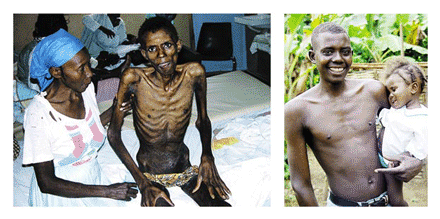
Last year I posted a link to this picture on World AIDS Day. This year I thought I would post the actual picture. I don't exactly have permission to post this image, but I hope that Partners in Health (PIH) would not be mad, because I always use it to help patients in the spirit of PIH's treatment model of free health care for the world's neediest patients. We actually have posters on the walls of our clinic in Busia with this same picture along with explanations in Swahili of the benefits of ARVs for patients with AIDS.

The picture is of a Haitian man with HIV and TB who was (and presumably still is) a patient in the Partners in Health clinic in central Haiti. The left is a "before" image, when he was sick with HIV and TB. The right side is the "after" image, taken just six months later, after he was treated for TB and started on antiretrovirals (ARVs). I generally show this picture to patients before starting them on ARVS. I think it expresses the power of ARV treatment better than any speech I could come up with.

Monday, November 26, 2007

Amsterdam


is too good to be true: picturesque waterways, restored townhouses, tolerant Dutch people zipping around on their bicycles. I didn't make it to many of the museums-- too distracted by the endless bars, cafes, and coffeeshops. The average corner cafe has a wide-selection of Belgian beers on tap, smoked salmon and watercress sandwiches on thick brown bred, and homemade apple cake. Three or four of those establishments on a single block! With so many pubs to patronize, how can anybody be expected to get anything done? We ate (dad with college roommate at candlelit restaurant, at left below) and shopped (wide-eyed sister at bonbon-central, at right below).


I'm back in Busia now, dragging the odd feelings that come with rapid movement between sleek European capital and rural Kenyan village. Downtown Amsterdam vs. downtown Busia pictured below.


Saturday, November 17, 2007

Holland

I'm on vacation in Amsterdam! I'm in heaven. I suddenly don't want to go back to Busia again. I'm going to stay in Amsterdam forever. More to follow.

Sunday, November 11, 2007

Stephin Merritt on Project Song


I'm sick of thinking about global poverty. This article about Jeffrey Sachs pushed me over the edge. One billion people living on less than one dollar a day? I need to block that stat out until I can deal with it. Instead, I'm holed up in our office trying to forget that I'm smack dab in the middle of a community that fits that definition.

I'm entertaining myself with the new NPR music website. I'm not usually a big NPR fan. It's probably just a rebellion thing, because my parents always had it on in the car when I was little. But this new NPR music website is the coolest! They have music reviews, mp3s for download, musician blogs, live concert streams, and "project song" reports.

In Project Song they give a musician 48 hours in a fully equipped studio to write a song that is supposed to be based on a word and a picture. Stephin Merritt, the brilliant lyricist of the Magnetic Fields, wrote a song based on the word 1974 and the picture above left. You can watch a video of the creative process or hear the All Things Considered report here.

By the way, the Magnetic Fields have a new album coming out soon. They are also playing in NYC's Town Hall in February. I want to go if Lola or Yu will go with me.

Saturday, November 03, 2007

New Look

I was just trying to change the margins for a quote on that last post, but the code in the template style box gave me a headache. I changed the whole template instead. I like the colors in the new template, but the margins are still wrong. The body text is too long and skinny, and the side bar is too fat. There's no going back though, this is my new look, at least until tomorrow. Does anybody know how to change the margins? Lola, where are you when I need you?

PLoS Medicine- Poverty and Global Health Issue


Check out PLoS Medicine's October 22nd issue on global poverty and human development:

We asked a wide variety of commentators worldwide—including clinicians, medical researchers, health reporters, policy makers, health activists, and development experts—to name the single intervention that they think would improve the health of those living in poverty. We also asked four individuals living in poor, rural agricultural communities in the Santillana district, province of Huanta, Ayacucho, Peru to give us their response to the question, “What do you think would do the most to improve your health and the health of your family?” (The four community members were Severino Rojas Poma, Mercedes Vargas Soto, Julián De La Cruz Chahua, and Martín Rojas Poma). Our October 2007 Editorial discusses this debate further.

Of note, now that I live outside the ivory tower, I appreciate PLoS's open access publishing. What's with medical journals charging $30 to download scintific studies that were funding by taxpayer money in the first place? This is just another hurdle for students, researcers, medical schools, doctors, and hospitals in poor countries that can't afford subscriptions to scientific journals.

PLoS Medicine believes that medical research is an international public resource. The journal provides an open-access venue for important, peer-reviewed advances in all disciplines. With the ultimate aim of improving human health, we encourage research and comment that address the global burden of disease.

PLoS Medicine (eISSN 1549-1676; ISSN-1549-1277) is an open-access, peer-reviewed medical journal published monthly online by the Public Library of Science (PLoS), a nonprofit organization. The inaugural issue was published on 19 October 2004.

Thursday, November 01, 2007

Mama Chapati


sits right near our office every morning from about 6am to 10am.She makes these delicious things called chapatis, which are like a cross between tortillas and naan. When I walk past her on my way to work she shouts "Karibu Chapati," which I think translates to "welcome chapati," or maybe "you are welcome to chapati." My colleage at work said to to be careful of them, because apparently they "go straight to your hips." I buy one every morning nonetheless. They are definitely worth it.

Saturday, October 27, 2007

Send your old digital camera to Sue Johnson

My friend, the lovely and talented photographer Sue Johnson, has been working with a photography collective in South Africa for the past 3 years. I met Sue in 1987, right after she left St. Cloud Minnesota for college. She had a perm then, and looked a lot like Meg Ryan back in the When Harry Met Sally era. she doesn't look like that anymore, but she still has huge blue eyes and amazing legs. She's married, with two small children who were both born in South Africa. Sometimes she collaborates with her husband Joe on his Radio Diaries documentaries. Haven't heard Thembe's Radio Diary about living with HIV in South Africa? Go immeadiately to www.radiodiaries.org

Back to the photography collective: It's a mix of young people and long-time street photographers. They have been documenting their lives in the townships, one neighborhood at a time. Click on the link above to see their work.

Sue says the group is growing and they need more equipment. They are looking for
used:

* used point and shoot or SLR digital cameras (3.2 Megapixels and up)
* Battery chargers
* Flash Cards or Memory Cards
* laptops
* hard drives
* firewire cables and power chargers
* photography books for the library

If you have any of the above equipment lying around since you bought a newer model, consider donating it to Iliso Labantu. E-mail Sue at sue@suejaye.com, and she will arrange to get your donation to South Africa.

Iliso Labantu -- The Eye of the People

Thursday, October 18, 2007

Neighbors


These women sell roasted corn-on-the-cob at the side of the road near our house. They were delighted when I took their picture (at left above), and even happier when I gave them the hardcopy that I ordered from www.snapfish.com (at right below, with picture in hand). The woman in the middle called me "a nice mzungu." Now everybody on the block wants a picture.

Saturday, October 13, 2007

Found on Office Floor


Actually, right at the office doorstep. James the guard chopped it in half with a stick (note protruding innards). James doesn't know what this type of snake is called in English, but he assures me that it is dangerous.

Saturday, October 06, 2007

Fabulous


This is Christine, the administrative Assistant in our office. She wears fabulous outfits like this one every day. She's going to teach me how to tie an headress. Also, how to carry things on my head. I'm practically the only person in Busia who can't carry a 10 liter bucket full of water on my head.

Friday, October 05, 2007

Homesick


Western Kenya is interesting, but I've been thinking about New York this week. I miss visiting Aoibheann and her beautiful mzungu baby in Brooklyn (pic at left taken last May), then walking to Fort Green to sleep over at Lynnie's. I miss drinking whiskey with Lola while watching the Red Sox whoop the Yankees.

This ("X marks the Spot") made me miss the NYC nightlife. I've also been yearning for a visit to Economy Candy. And of course I miss my sister-- the hostess with the mostest--and her chocolate cake.

Thursday, October 04, 2007

Flood Report

Here is an interview with Elena, our head of mission, about the flooding in South Busia District.

Thursday, September 27, 2007

Floods in Budalangi


Since mid-August there has been flooding in the Budalangi region of Busia District. Part of a dyke near Mukabola health center gave way. The picture above shows people standing at the broken end of the dyke on day it collapsed. Apparently this happens almost every year at the end of the long rains. Year after year, the people in the area are displaced by flooding until the water evaporates and the dyke is repaired. Then they go back to their regular houses, or build a new hut if the old house was destroyed. According to members of our team who work at the health center, the water levels are higher this year and more people are displaced into makeshift camps. I'm hoping they build a stronger dyke this time around. They said the last one was weak becuase it was built by a "lady engineer."

Because MSF is a NGO dedicated to medical care in vulnerable populations, we are focusing mostly on health-related consequences of the floods. Gabriella, the doctor I work with from Argentina (pic in canoe below), goes out by bike, boat, and on foot to make sure the rural clinics have enough medicine and supplies. The logistics department also helped with building latrines and distribution of water tanks, mosquito nets, and water purification tablets. The pictures below show people displaced by the floods in their camps.